
Pronatalists want to boost birth rates with Sunday closures and internet limits
 adminUpdated 3 hours Ago4 Mins read
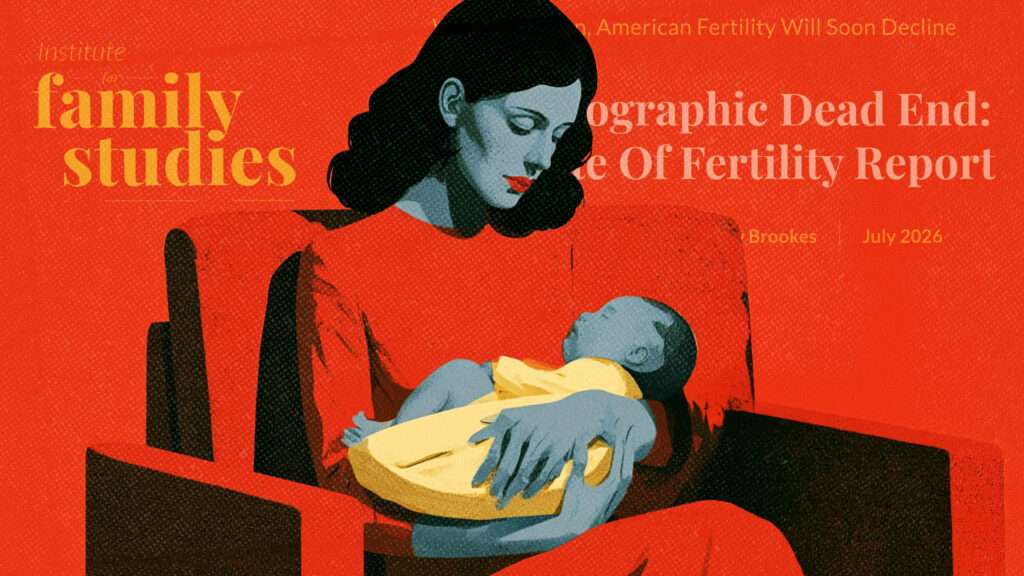
It’s Sunday. You want to go into town to run errands and perhaps see your friends at a bar, but you stay home because blue laws have forced businesses to close on the Lord’s day. You consider going online, but there is an excise tax on data usage, and all non-essential webpages have been disabled for the day. You have been invited, however, to a city-sponsored lecture by a C-list celebrity on the importance of restoring the fertility rate. Do you want to have a baby now? Are you feeling in the mood?
This may sound like an outlandish scenario cooked up by Margaret Atwood or a pussy-hat Resistance lib, but bringing back blue laws, impeding internet access, and enlisting celebrities to promote fertility are all real proposals from the pronatalist nonprofit, the Institute for Family Studies (IFS), outlined in its 2026 State of Fertility Report released on Tuesday.
With U.S. birth rates now below 1.6 children per woman, IFS warns that cultural and sometimes political interventions are necessary to increase the fertility rate, as “the future of liberty for all of us depends on the future of family.” And so, in pursuit of “the future of liberty,” IFS proposes a litany of social-engineering policies that restrict freedom and empower the government.
Many of the proposal’s reforms are conventional and similar to the pro-family, big-government politics of Sen. Josh Hawley (R–Mo.): doling out baby bonus money and child caregiver credits, eliminating marriage penalties in tax and benefit programs, and incentivizing more housing. As Reason’s Elizabeth Nolan Brown has noted, many of these top-down pronatalist policies often fall short of meaningfully increasing the birth rate.
IFS not only proposes individual pro-family policies; it also proposes a holistic change to the lawmaking process itself, suggesting that Congress and state legislatures evaluate bills by their impact on marriage and fertility, “giving legislators a constant reminder that their choices have consequences for the physical survival of the nation, not only of its financial accounts.”
The other IFS proposals about changing societal fertility norms are even more bizarre, including recruiting celebrities to convince the public to have kids. One of the IFS graphs asserts, “When celebrities have more kids, their fans want more kids.” This finding is hardly scientific; instead, it demonstrates an association between a fan’s desire to have children and the number of children born to a celebrity. In other words, pro-family fans seem to like pro-family celebrities.
Per the IFS methodology, the researchers asked respondents to “report a public figure whom they most admired and why.” They then collated the reports and identified how many kids each celebrity had based on public information. They then found “that each additional child born to an admired public figure predicts higher desired family size for the survey respondent,” and these effects were “more statistically credible” for women.
The graph in the IFS report says it controlled for the following factors: college degree, recent household financial change, household income, sex, age, and satisfaction with housework level. Notably, the celebrity study does not appear to control for a key predictor of having children: religiosity (as past IFS studies have shown, religious Americans tend to have higher fertility rates than secular Americans). The IFS appears to acknowledge religiosity as a possible confounding variable elsewhere in the report, but does not account for it in the celebrity model. Political affiliation could also be another confounding variable, but it is not mentioned in the celebrity study.
Based on this association (which may be caused by fans having pre-existing values that likely align with those of their favorite celebrity), IFS claims that “enlisting celebrities to promote American family life may work.” The Institute then suggests that “governments interested in boosting fertility should consider enlisting the support of celebrities popular in their jurisdictions, or perhaps even finding a way to obliquely encourage those celebrities to marry and have more children.”
What would this social engineering look like? Would taxpayers foot the bill for vapid PSAs by Abby Shapiro telling people to increase the fertility rate for the good of the nation? Could they make a more convincing case than Eric Adams, who famously encouraged New Yorkers to make babies during a snowstorm? Would a government official be responsible for secretly recruiting celebrities to have children?
The government-sponsored baby-making propaganda team would also have to carefully select its celebrity ambassadors if IFS is to follow its own standards. The celebrity recruiting team would likely want to avoid someone like Alex Cooper because she is, according to an IFS contributor, a “grifter and a liar” for promoting hookup culture and then getting married and having a baby, although her life path is rather conventional.
IFS also suggests some more “creative options” to increase fertility rates, including forcing businesses to close on Sundays in a paradoxical effort to create “in-person community.” It also floats impeding “access to non-essential digital services on certain days or at certain hours” to push users offline and promote real-life socializing. IFS suggests these policies may increase fertility, as it claims research suggests that iPhones, pornography, and social media are negatively impacting U.S. fertility. But, as Reason has noted, the evidence supporting the smartphone theory of falling birth rates is disputable. And supposing the digital revolution is to blame for falling birth rates, this solution would curtail internet freedom. A nonprofit monomaniacally devoted to increasing the population sees no issue in suggesting censorship measures to encourage fertility, but the rest of Americans may object to this.
In its report, IFS acknowledges that restoring the birth rate is a largely cultural and social matter. And yet, it proposes several government-enforced policies—some of which read like a bizarre Nathan for You-style scheme—to increase the fertility rate. This approach fails to recognize that Americans do not trust their government, and they most likely do not want to be manipulated into having children by technocratic policymakers.












Leave a comment