
A slow, boozy bus tour of Hungary’s secret vineyards | Travel
 adminUpdated 2 hours Ago4 Mins read
The 90-minute train journey south-west from Budapest to the spa town of Balatonfüred unveils a landscape that segues from gritty industrial compounds to long sweeps of golden sunflowers and fields of pale grain. The carriage is pleasingly retro, with thick velour upholstery; windows that open, awkwardly, with a stiff metal lever; and a bushy eyebrowed conductor replete with ticket machine slung over his shoulder.
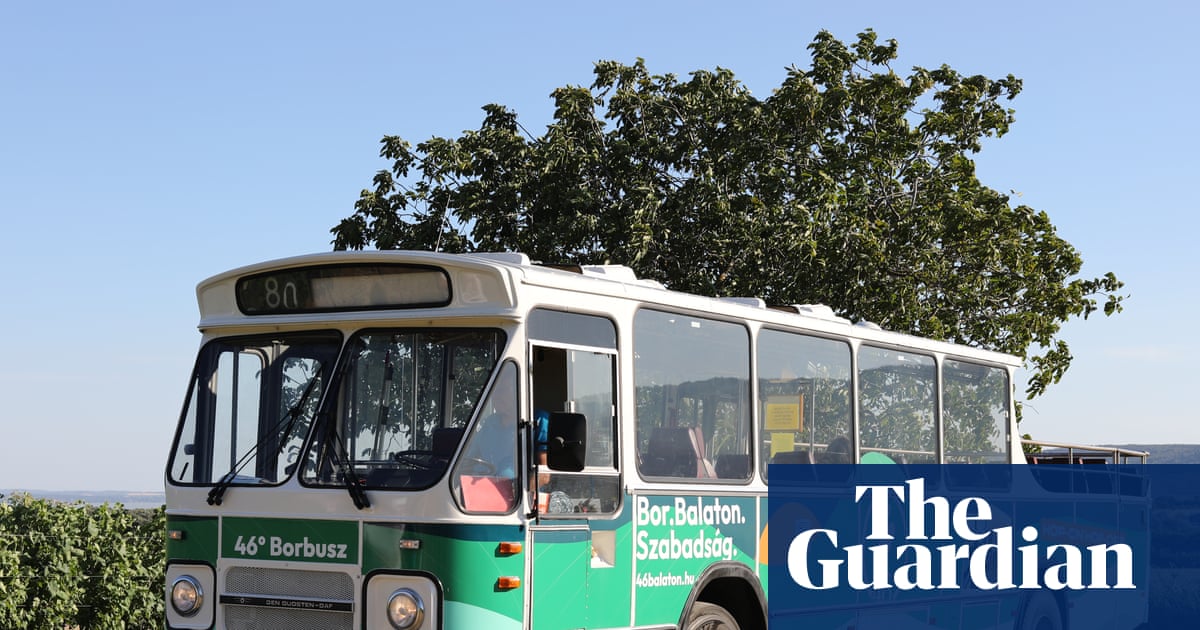
But the real retromania is yet to come. Arriving at Balatonfüred station, I board a 1984 DAF bus, painted an almost audacious shade of green. From the open-air rear, I take in the view over Lake Balaton, central Europe’s largest freshwater lake, often referred to as the “Hungarian Sea”.
A spa resort town since the late 18th century, Balatonfüred is a popular place for sailing and swimming, while the hilly countryside to the north is great for mountain bikers and hikers. It’s also home to hundreds of wineries, many of which have traditionally been difficult to access – especially without a car. The bus I’m on – the hop-on, hop-off 46° Balaton Borbusz that launched this summer – has changed all this, by taking visitors on day trips to local vineyards.
It’s the brainchild of Virág Szabó, who has spent summers in the region since childhood. “The idea first came to me when I was travelling in South Africa, on the vintage wine tram that runs between Stellenbosch and Franschhoek,” she says. “I couldn’t believe that nobody had thought to do something similar here.” The 46° moniker is a reference to the fact that this area occupies the same latitude as Bordeaux, Burgundy and the Rhône.
She found the bus in the Netherlands and, by May this year, had signed up 22 wineries along two distinct routes – one focused on better-known growers and the other on more remote ones. Since then, seven more have joined and many more are eager to get involved. “I have three criteria. Is the wine good? Are there nice views? And is the winery able to offer some form of hospitality?” she says. Many of the wineries are family-owned and run, with no previous thought of opening up to visitors. Very little of Hungary’s wine is marketed, and only around one-third is exported. Less still has it ever been the stuff of tourism.
The bus departs Balatonfüred about every two hours from 11am, with the final drop-off at 9pm and the option to visit four wineries. Guests can either choose these in advance or pick en route – and, if the bus returns for you and two hours have flashed by before you’re ready, you can simply ask to be collected two hours later. While tourism in Hungary is booming, with Budapest the country’s primary draw, the Borbusz hopes to lure visitors further afield, offering an alternative insight into the country – and the chance to meet local people. Originally, it was planned to run only until September – but will now operate until mid-October, thanks to its early popularity.
Our first stop is Mórocz Pince (“pince” is the Hungarian for “cellar”), reached via a moderately steep, rocky path from the main road. Founded by former musician Tamás Mórocz, it produces between 4,000 and 5,000 bottles each year, with traminer and merlot rosé among its specialities. “During Soviet times, the emphasis was on quantity, for exporting to eastern bloc countries, rather than quality,” he says. “Fortunately, that’s no longer the case.”
Although just 38, Mórocz has been making wine for 15 years. “I wanted to approach it differently,” he says. “In a way that was lighthearted, irreverent and down to earth.” One way he’s achieved this is through his labels, with each vintage given a different theme. The 2025 bottles show photos, taken from family albums, of his grandfather, who introduced him to wine. “He died in 2012, so he doesn’t know he’s famous,” says Mórocz, with a smile. Over charcuterie platters on the terrace, with rows of vines and the expanse of the lake as a backdrop, it feels less like a tasting, and more like we’re drinking and chatting with friends – and the wine is delicious.
We continue on, and some of the group jump off at another winery, Balogh, just down the hill from Mórocz. But Szabó has told me about the charismatic owner of Gazdag Pince, and I’m keen to meet him, so I remain on the bus for another 15 minutes as we pass neatly combed vineyards and pretty villages. “We only make wines that we want to drink,” says Gábor Gazdag, welcoming us to his winery. “I used to play badminton, but then I got too fat, and I started worrying about being bored in retirement. I wasn’t interested in hunting, fishing or collecting stamps – but I like wine, so I bought this land. It’s a hobby for me.”
For Gazdag, this may be a way to stave off lethargy in older age; for János Fogl, at next door’s Madaras Pince, “it’s my life”. Szabó tells me that Fogl – who has been making wine since 1994 – is a genius, cross-breeding grapes to create unique varieties that shouldn’t work in this region. Shaded under a vine-tangled trellis, we start with a cherry liqueur before moving on to a dizzying selection of wines. Each time I think we’re finished, Fogl shuffles off to his cellar and produces another bottle.
Music spills from the Borbusz speakers as we travel back, picking up passengers – couples and groups of friends – from other wineries along the way. Everyone is in an unmistakably ebullient mood; this will almost certainly turn to somnolence later.











Leave a comment