
Trump’s World Cup intervention shows his sore loser philosophy
 adminUpdated 7 hours Ago5 Mins read
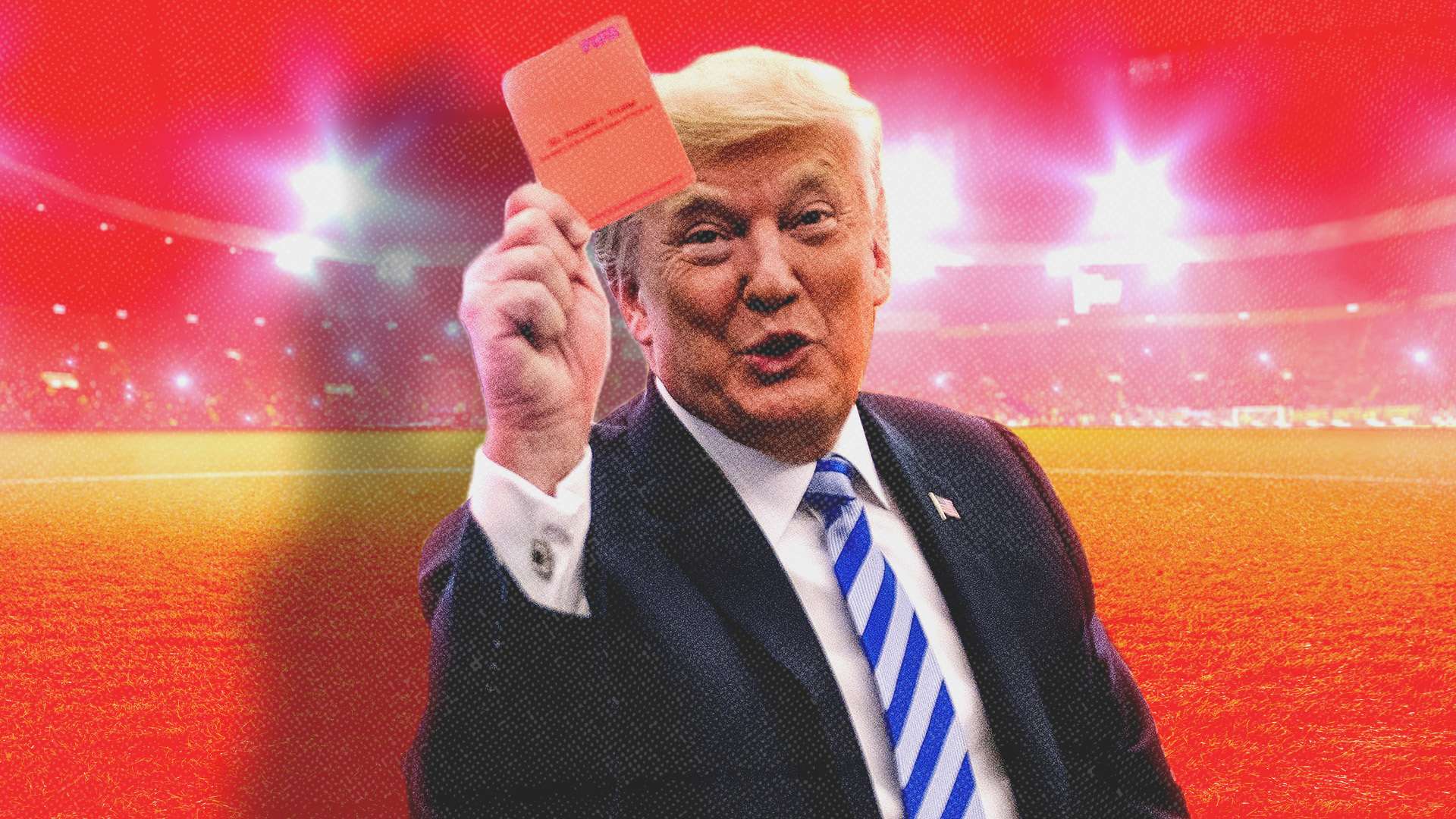
It would have been amazing to see Americans take home our first World Cup on our country’s 250th birthday—and during a year that we’re hosting. Sadly, that dream was dashed on Monday night, when Belgium beat the U.S. in Seattle 4–1. What made the loss especially embarrassing was that President Donald Trump had tried to tilt the scales in America’s favor.
FIFA, the international soccer federation, agreed on Sunday to overturn its suspension of star American striker Folarin Balogun, under pressure from Trump. Balogun had gotten the red card for stepping on the ankle of Bosnian player Tarik Muharemović during his last game. Some observers, such as former elite referee Andy Davies, argued that the incident was a normal accident and Balogun should never have gotten suspended.
Trump channeled his inner Karen and complained to the manager. His advisers assembled lawyers and dug up a past complaint against one of the referees for Trump to bring to FIFA President Gianni Infantino. FIFA agreed to reverse the decision. (Infantino denies any undue political influence.) It was the first such reversal since FIFA’s cartoonishly corrupt decision for Brazilian player Mané Garrincha in 1962.
While Trump’s supporters tried to make the incident into an example of American badassery, Belgians portrayed it as unmanly and unsportsmanlike. After scoring Belgium’s fourth goal, Romelu Lukaku made a mocking phone call gesture, and the team posted his photo to Instagram with the caption, “Overturn this.”
The issue isn’t about whether the referees made a bad call for Balogun, which happened plenty of times during this World Cup. The issue is that the U.S. government got involved in a sore-loserish way. (Trump didn’t even threaten the referees with violence like a traditional American mafioso, instead deciding on a more weaselly course of action.) Balogun himself didn’t ask for Trump’s help and was ready to accept the referees’ verdict before the game.
“There’s still lots of people we’re inspiring, little kids, boys and girls who are watching, and we have to show them the correct way to handle things, even when you think it’s unjust,” he told reporters on Friday after receiving the red card. On Monday night, Belgian coach Rudi Garcia said that Balogun “came to talk to me, I really like that. It’s not his fault, he’s not the one to blame and that’s what I told him.”
The politicization of FIFA is a microcosm of Trump’s foreign policy approach: Good faith and fair play are for suckers. Breaking the rules is a form of creative leverage. What starts as a search for inefficient restrictions turns into a strategy built around cheating—with questionable returns. In the end, a few unfair advantages often aren’t enough to salvage a bad strategy, and the U.S. fails anyway.
Of course, there is a real appeal to rule breaking. Many “norms” in politics are simply bureaucratic red tape or weird establishment hang-ups, and having to work around them can be frustrating when people’s lives are at stake. In the beginning of the second Trump administration, I was tempted by the idea that Trump’s disdain for political pieties might be the key to world peace. Likewise, left-of-center voices from New York City Mayor Zohran Mamdani to The Argument editor Jerusalem Demsas seemed happy with Trump giving corrupt FIFA officials their comeuppance.
But some rules really do keep conflicts limited, opponents honest, and the helpless out of the battlefield. Trump complains about “politically correct” rules of war that don’t allow the U.S. to torture prisoners or kill the innocent family members of its enemies. He has used negotiations as a ruse to start wars, mused about shooting the messenger as a form of leverage, and bragged about not keeping up his end of deals. It goes without saying that loosening the restrictions on geopolitical conflict has terrible consequences for people’s lives, from fishermen in the Caribbean to schoolgirls on the Persian Gulf.
A bad faith strategy also runs into a more practical problem: Perfidy only gives one side an advantage because of the other side’s expectation of good faith. Breaking the rules is a leg up if the other side is still following them. Shooting the messenger works if the other side expects messengers not to be shot. Most world leaders aren’t Charlie Brown, naively waiting for Lucy to yank his football away over and over again. When a government behaves like an unreliable actor, other governments treat it as unreliable.
The proof is in the pudding. Despite having two years to test his theories of war and peace, Trump hasn’t gotten his way in Ukraine, Yemen, Greenland, Iran, or China.
Ironically, Trump’s approach worked in business—and soccer—because of the stronger enforcement of rules. Businesspeople have to continue assuming that contracts will be enforced by the courts, because in most cases, the courts will enforce them. If the Belgian players tried stepping on American players’ ankles, then FIFA would presumably punish them, despite its leniency for Balogun. Rule breaking is only a winning strategy within a system of rule-followers.
It follows that corruption in such a system works best with some level of plausible deniability. Past attempts to corrupt FIFA have been made with winks, nods, and under-the-table bribes, because again, cheating is only an advantage when everyone else assumes fairness. Trump may have overstepped by making his pressure on Infantino public. In international politics, Trump has tried to replace the notoriously compromised United Nations with an openly biased Board of Peace, made of countries that promise to pay tribute into a slush fund he controls. No surprise, the promised billions of dollars haven’t arrived.
Soccer is not just a parallel for Trump’s foreign policy. It’s also a venue where he has tried to pursue his specific agendas. Infantino and FIFA have been enthusiastic partners to the Board of Peace, inventing a peace prize to award Trump and promising to build stadiums on the ruins of Gaza. And the Trump administration has used the U.S.’ host status to flex its political muscles against other World Cup participants, mostly with humiliating border procedures.
After all, the World Cup began just after Trump signed a peace memorandum with Iran. Hosting the Iranian team could have been an opportunity to send a variety of different messages: The war is over, and we are turning over a new leaf. Or Americans support the Iranian people despite their government. Or the United States puts its commitments as a sports host above politics.
Instead, the Trump administration decided to give the Iranian players a series of petty hassles, refusing to grant their visas until the last minute, forcing them to fly in and out of U.S. cities on the same day as the matches, and taking away their fans’ ticket allotment. These hassles aren’t big deals in the grand scheme of things, but they are a sign of an attitude that is neither sportsmanlike nor gracious.
While Iranian players thanked Los Angeles for its hospitality and waxed poetic about peace among nations after their last game against Belgium, the Trump administration gloated about its power over those players off the field. “I was so happy when we were able to pull their visas,” U.S. Homeland Security Secretary Markwayne Mullin said at a briefing after Iran was knocked out of the tournament. “I might’ve sung a song or two or maybe even danced a happy dance.”
Unlike in war, winning isn’t the only thing that matters in soccer. Just compare Cape Verde and Paraguay. Although both of them were eliminated from the World Cup over the weekend, Cape Verde was remembered for its tough playing and honorable sportsmanship throughout the tournament. “Regardless of yesterday’s result, Cape Verde have emerged as winners,” Portuguese player Nelson Samedo told reporters.
Paraguay, on the other hand, became known for its embarrassing antics against France and a Paraguayan senator’s racist rant against French star Kylian Mbappé.
American players themselves fortunately did not stoop to Paraguay’s level. The team played well against Belgium and took its loss with grace. “I accepted the decision when I was given the red card, and then I also accepted the decision when I was told I could play,” Balogun said. “There’s not too much else I can really say on the matter. I think all that being said, Belgium were a better team today. They played much better than us, I feel.”
But the Trump administration and its supporters did stoop low, making it clear that they see sports as an extension of their underhanded political approach to foreign friends and foes alike. And the worst part is that it didn’t even work.







Leave a comment