
Afghan Special Forces Veteran Died in ICE Custody After Officers Denied Him an Inhaler
 adminUpdated 2 hours Ago5 Mins read
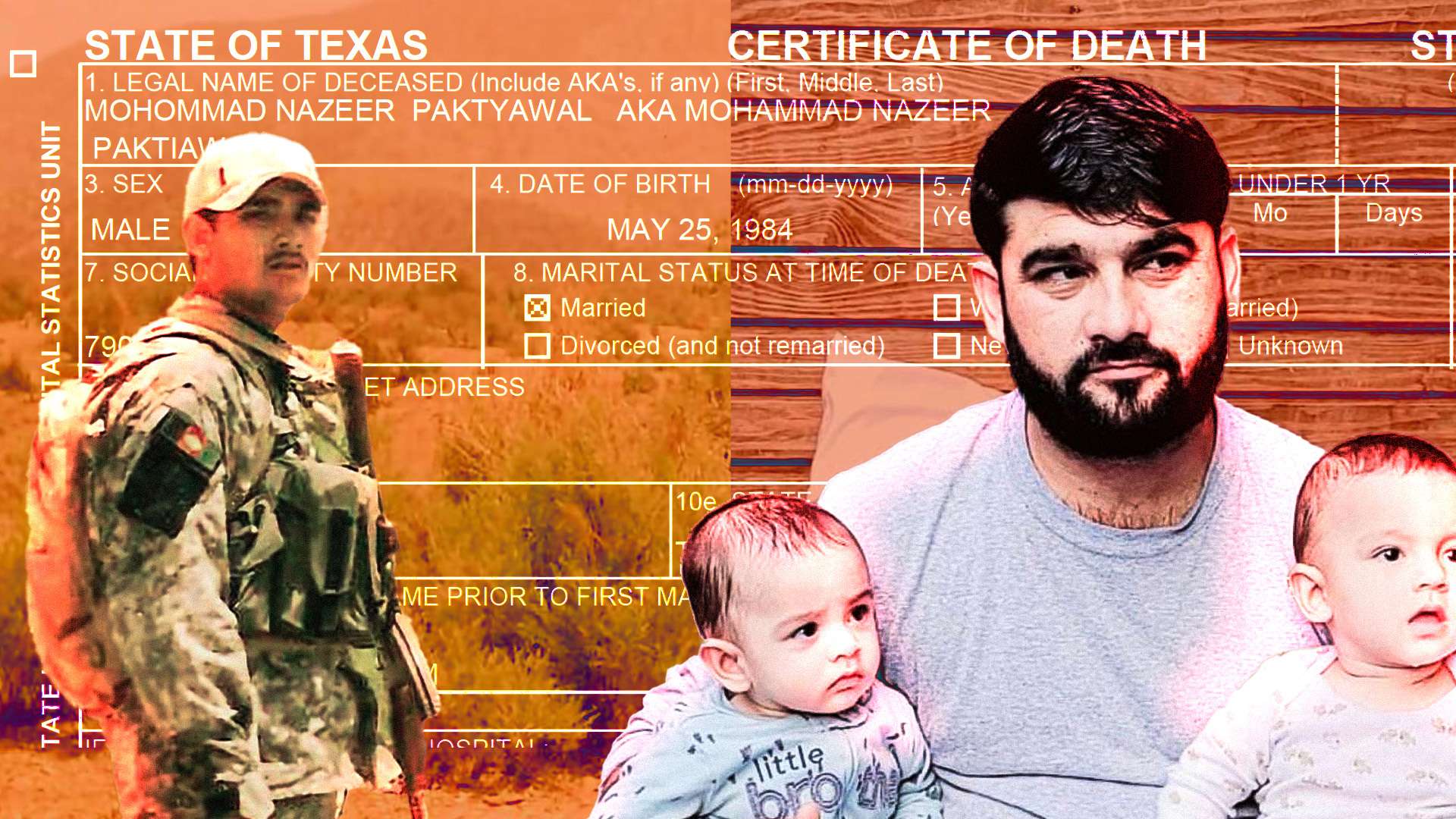
On the morning of March 13, Afghan immigrant Mohammad Nazeer Paktiawal was taken into custody while preparing to take his children to school. His wife told Immigration and Customs Enforcement agents that Paktiawal required an inhaler to breathe. She said officers did not take the inhaler and did not allow her to provide it later. Within 24 hours, the former Afghan National Army Special Operations Command soldier was dead.
Paktiawal began to experience shortness of breath shortly after arriving at an ICE detention center. When he called his brother, Naseer Paktiawal, to alert him to his condition, his brother reported a medical emergency at the detention center. Paktiawal was taken to Parkland Hospital at 11:30 p.m. He was stabilized, but began to experience swelling of his tongue as he ate breakfast. He died forty minutes later, around 9 a.m. His family was not alerted to his death until noon.
It took more than three months following Paktiawal’s death for the Dallas Medical Examiner to release any more details, listing his cause of death in an online database as an “accident.”
Though an autopsy has not been forthcoming, a death certificate, shared with Reason, shows that Paktiawal’s immediate cause of death was anaphylaxis, “complicating acute asthma exacerbation.” The death certificate further describes Paktiawal’s time and place of injury as 11:30 P.M. at Immigration and Customs Enforcement in Dallas on March 12, which was almost 12 hours prior to his arrest on March 13. They say that the injury occurred in the aftermath of “adverse drug reaction and ingestion of [an] illicit drug.” The certificate notes “toxic effects of methamphetamine” in addition to “atherosclerotic cardiovascular disease” and smoking cigarettes as significant conditions that contributed to Paktiawal’s death.
AfghanEvac president Shawn VanDiver tells Reason that when he requested the autopsy from the Dallas Medical Examiner, he was told that an ICE official recommended that Paktiawal’s autopsy be barred from release. “If the death certificate’s toxicology finding is accurate, no government agency has explained how a man who had been in ICE custody for less than 24 hours could have been exposed to an illicit substance, or whether investigators believe the exposure occurred before or after he entered government custody,” VanDiver tells Reason.
VanDiver notes that an independent forensic examiner was unable to perform a separate toxicology test because Paktiawal’s body had already been embalmed at the time of examination. VanDiver says that the independent examiner had multiple points of contention with the Dallas Medical Examiner’s analysis, including the probability that asthma led to Paktiawal’s anaphylaxis.
The Dallas Medical Examiner did not respond to Reason‘s request for comment.
Paktiawal’s brother, Naseer, tells Reason that he never knew Paktiawal to use drugs, or even smoke cigarettes after he gave up the habit two years before his death. Paktiawal drove semi trucks before Texas stopped issuing commercial driver’s licenses to noncitizens in September 2025. “A person who used drugs, he’s not going to pass a duty physical checkup” as a truck driver, Naseer explained. “When he was driving a semi truck, you have to go through a duty surgical checkup, which tests for everything,…your blood tests, your hair, your mouth, even for your urine.”
Naseer says members of the local Afghan community ask him daily about the results of Paktiawal’s autopsy. “They say, ‘We’re not in Afghanistan, we’re in America. Why is it taking so long?'”
In the aftermath of his brother’s death, Naseer is driving a big rig to support his own four children as well as Paktiawal’s wife and six kids. “I don’t need any support from this government to support his family or my family,” he says. “The only thing is that I need to know what exactly happened to my brother.”
Rather than answering questions about Paktiawal’s death, federal agencies have spread falsehoods about the 41-year-old father. In its own statement announcing Paktiawal’s death, ICE called him a “criminal illegal alien,” referencing two prior arrests for alleged SNAP fraud. NBC reported that federal officials said Paktiawal provided “no record” of his service with the military.
On the contrary, VanDiver reports that Paktiawal served alongside U.S. Army Special Forces in Afghanistan for more than a decade of service in the Afghan National Army Special Operations Command. He and his family were evacuated to the U.S. during the August 2021 Afghanistan withdrawal and he was pursuing permanent residency in the U.S. through an active asylum case, according to VanDiver.
Naseer says that his brother “was not just like a regular person, you know, coming to this country. He was in the war alongside American troops with the Special Forces, and shoulder by shoulder they fought together against the Taliban.” Naseer explains that when Paktiawal was brought to America, he believed that everything he went through was worthwhile, because it would give his children “a better life” than they would have under the Taliban. “He survived the Taliban, he survived the war, but he thought that this was going to be a safe haven for him and for his family, but he was wrong.”
Naseer says that “the hard part” is when his brother’s youngest child, who just turned 3, asks when his father is coming home. “I have nothing to say to him,” Naseer explains. “The pain that I’m going through with this family, trust me, it’s not easy looking at their eyes, asking for their dad.”
In a press statement to AfghanEvac, Rep. Julie Johnson (D–Texas) said that Paktiawal’s “family deserves to know exactly what happened. Congress deserves answers, and the American people deserve transparency whenever someone dies in federal custody.” Johnson said that “instead we’ve been met with silence,” with no answers about the medical care provided, the officers’ response time, the lack of an immediate ambulance dispatch, and whether there is video of Paktiawal in custody. “Transparency is not optional,” Johnson added. “Accountability is not optional. There is no excuse for not releasing the autopsy to his family, even if the case is still under investigation.”
Sen. Richard Blumenthal (D-Conn.) told the press in June that “failure to produce the evidence and facts are part of a conspiracy to conceal the truth from the family and from the American public.” He added that Paktiawal “came to America believing in the greatest nation in history” and “was seeking asylum from some of the most brutal and violent forces in another country, where he was an instrument for freedom and democracy. He came here seeking the best. What he found was the worst in our nation.”
Between 2009 and 2024, Reuters reported that one inmate died on average per 3,848 detainees at immigration facilities. Since 2025, one inmate has died per 1,630 immigration facility detainees. Reuters notes that the more than 50 immigrants who have died in ICE custody since President Donald Trump took office represent a 100 percent increase in immigrant deaths under his current presidential term.
VanDiver has traveled to Texas several times to meet Paktiawal’s family and the impacted community. “I’ve learned that these stories are never about policy, they’re about people,” he said in June. Paktiawal “was not a case number, he was not an immigration file,” VanDiver said. “He was a father, he was a husband, he was a brother, he was a teammate. He was someone whose children expected him to come home.”










Leave a comment