
The separation and expansion of powers between Congress and the president
 adminUpdated 3 hours Ago2 Mins read
SCOTUSBlog has published the final installment in our series on recent changes in constitutional law. This essay focuses on the separation of powers. It begins:
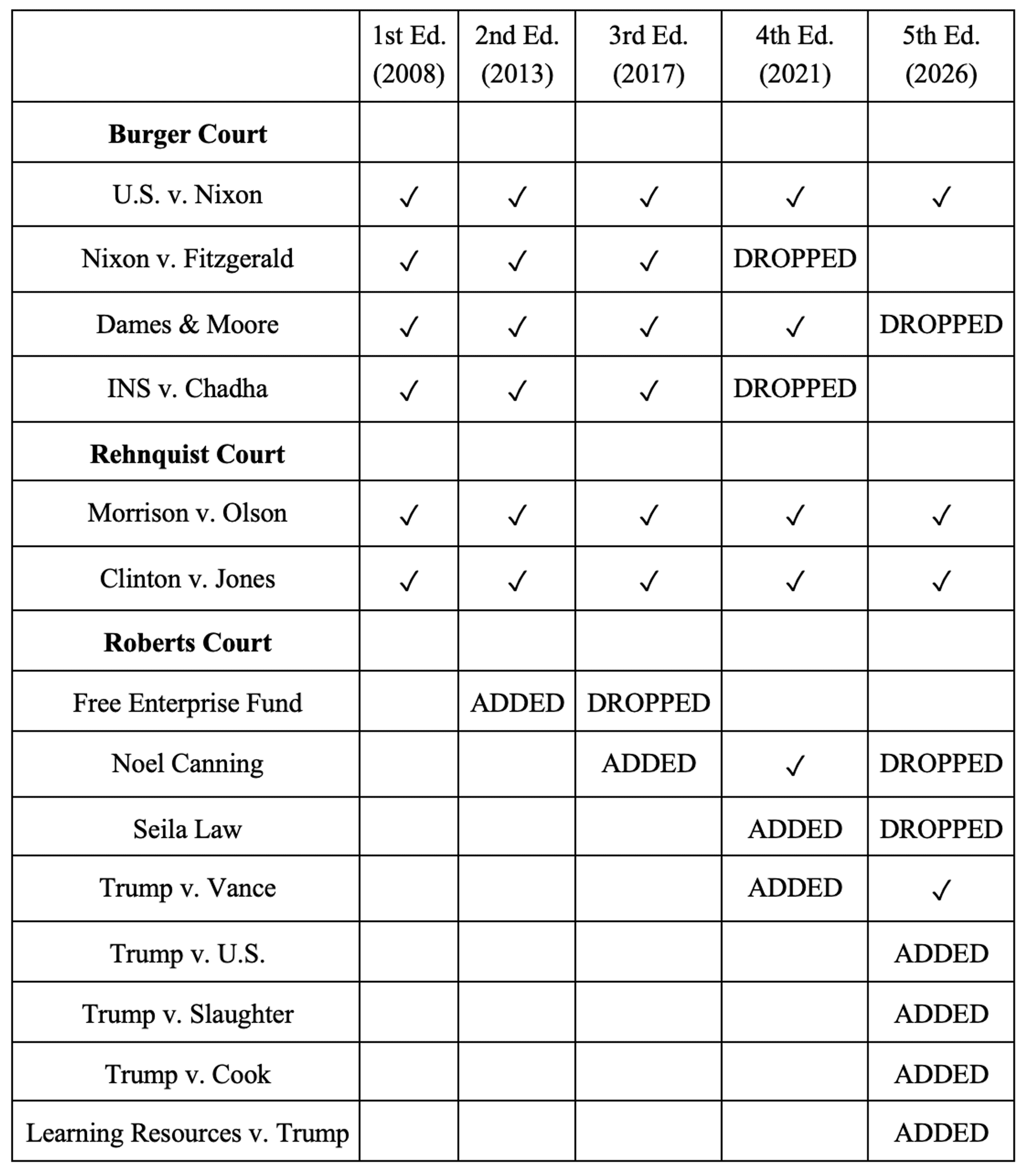
The late 1990s and early 2000s ushered in the Rehnquist federalism revolution, which appeared to place limits on Congress’ powers and expand those of the states. Then came Sept. 11, 2001, and the global war on terror, which seemed poised to expand the president’s powers. Yet, by 2008, Congress’ powers seemed without meaningful limits and the president’s efforts to expand his own powers had failed. And the separation of powers remained, well, separate. Nevertheless, the next two decades would vastly enlarge the president’s powers as Congress’ authority over the executive branch would be greatly diminished.
Here is a chart that shows the shift in cases:
Here is our conclusion:
Up to the fourth edition of our casebook in 2022, constitutional law followed a somewhat predictable arc. To be sure, there were shifts to the left and to the right, but the doctrine could be explained by a coherent narrative: the New Deal settlement on federal power was untouchable; the court would offer only modest protections for federalism; the administrative state was beyond reproach; attempts to single out unpopular groups would be halted; “benign” racial classifications were permitted; and church and state were strictly separated. Now, each aspect of this narrative has been reconceived. The five years since that edition appeared have brought the most changes to constitutional law since the Warren court.
We began this series by observing that lawyers tend to internalize the constitutional law that existed when they attended law school. The same is true of law professors. Virtually all law professors today came of age in a time of stasis. They could safely assume that the trajectory of the Warren court would continue indefinitely. But the jurisprudence of the Burger and Rehnquist courts was primed for a reversal, just as the Warren court reversed so many precedents from before. Ultimately, the Roberts court continues to chip away at precedents from the 1970s and 1980s, even if the precedents from the 1960s and before remain.
Many of these professors have struggled to cope with sudden changes in the doctrine. Some have voiced their despair of teaching constitutional law at all. Unsurprisingly, their students also struggle to cope with these developments. This trend is regrettable. Our role as casebook editors, and constitutional law professors, is to guide students through the entire corpus of constitutional law, from the framing to the present day, without any nostalgia for, or bias against, times gone by.
This is my last planned post with SCOTUSBlog. I’m sure there will be more to come.









Leave a comment