
‘Barbecue plus one’: My friend’s genius solution for feeding the masses without sweltering next to the coals | Food
 adminUpdated 1 hour Ago5 Mins read
While I am glad to be home in Rome, it was particularly hard to leave England this year. After a few days in London, we spent two weeks between Dorset and Devon, in gardens or on the pebble beaches of West Bay, Lyme Regis and Branscombe. Thrashing around in the sea has never felt so necessary. There was also plenty of good eating, the air filled with suggestive scents – of fat dripping on to hot coals, sun cream, insect spray and lavender. Which brings me to the theme of this newsletter: a barbecue plus one.
The term is actually borrowed from an Australian friend. It is her solution to feeding lots of people well without too much work or clearing up: one thing on the barbecue (be it sausages, chicken, slices of cheese, kebabs or vegetables) plus one enormous bowl of something else. The solution came about after a particularly chaotic afternoon when her kids were all young, for which she made loads of dishes and compromises, and still didn’t manage to make everyone happy. Clearing up, she thought: “Thats it – next time it is going to be one or two things on the barbecue plus the biggest bowl in the house, filled with one substantial dish.” If I am being precise it should be ’barbecue plus one’, plus pitta bread, so helpful people can stuff the item from the grill, plus the bowl ‘thing’ into a pitta pouch, avoiding the need of a plate, plus sauces in squeezy bottles.
The following is her list of suggestions for that plus one, along with some things we made in Branscombe – jollof rice, roasted aubergine with tahini dressing, coleslaw, Greek salad, tabbouleh, ratatouille and caponata.
Jollof takes many different forms (and names) depending on the region. Nigerian chef Aji Akokomi has a particularly good version, which includes basmati rice, curry, thyme, ginger, red peppers and fish sauce, and has a crispy, toasty layer that forms on the bottom of the pot. Akokomi explains that jollof rice’s rich, complex combination of sweet, umami and spice goes well with marinated lamb, barbecued carrots and halloumi. Kate Young developed a jollof rice recipe after reading about it in Americanah by Chimamanda Ngozi Adichie: “She made him the kind of jollof rice he liked, flecked with bits of red and green peppers and, as he ate, fork moving from the plate to his mouth, saying, ‘This is pretty good,’ as he always had in the past, she felt her tears and her questions gathering.”
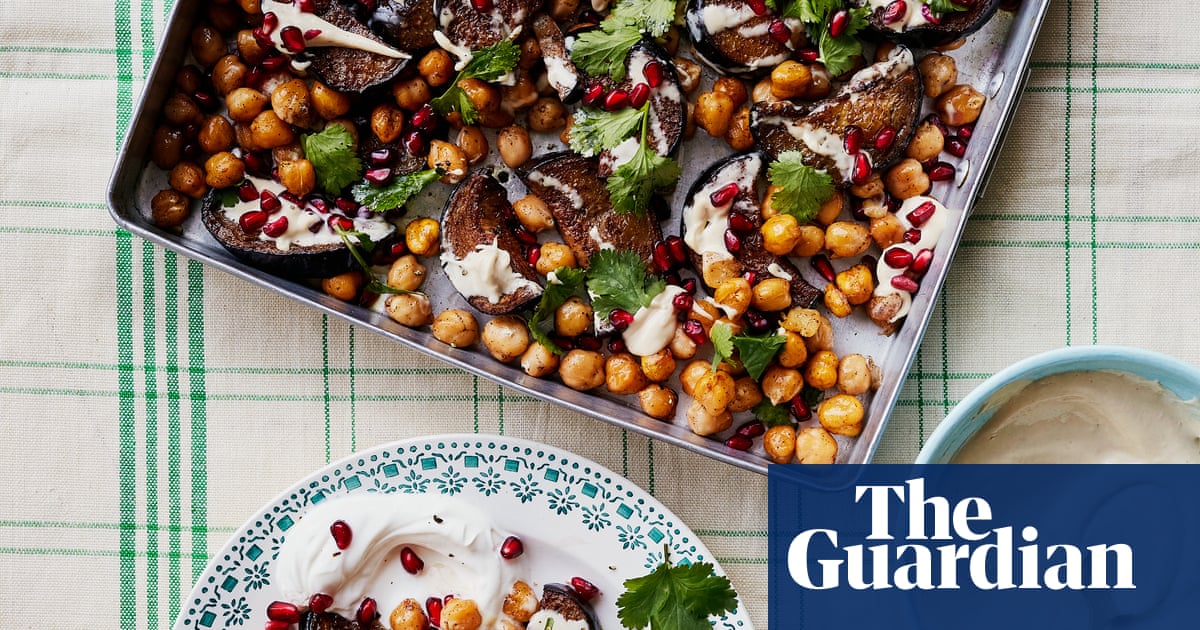
The next suggestion for the “big bowl” is Claudia Roden’s batinjan bil rumman wal laban, which is grilled aubergine on a base of yoghurt and tahini with pomegranate seeds. Rukmini Iyer also provides us with a quick and easy version of this with her roast aubergines, chickpeas and pomegranate traybake (pictured top). The third suggestion is coleslaw – Felicity Cloake has lots of thoughts about that.
If you can find tasty cucumbers (the small Lebanese ones are particularly good), great tomatoes and meaty olives, Greek salad is the ticket. Nigel Slater’s recipe is pretty classic, while David Carter’s version has real zing from the galomizithra, a soft sheep-and-goat’s-milk cheese from Greece’s largest island, while carob rusks add crunch.
Most of us visualise tabbouleh as bulgur with specks of herbs – however, in Lebanon it is the other way round, a mass of green with specks of bulgur. At their restaurant Moro, Sam and Samantha Clark sit somewhere in the middle with their tabbouleh, which they describe as a mineral tonic of a salad with finely chopped parsley, soaked bulgur, tomatoes, mint and onion, seasoned with olive oil, lemon juice, salt and pepper.
Chef Joudie Kalla, whose family comes from Palestine, brings together the many versions eaten and prepares tabbouleh with maftoul, a large-grain couscous which soaks up flavours. She also adds dried mint for sweetness, pomegranate molasses for its sticky sourness, depth, richness and colour, and chilli flakes for heat.
I am happy if the bowl is full of ratatouille. Felicity combines aspects from Raymond Blanc, Gui Gedda and Marie-Pierre Moine, and American chef Thomas Keller for her perfect version. Similar in style is Nigel’s classic recipe, while Adam Byatt is inspired by confit byaldi, a ratatouille-variation by French chef Michel Guérard. He arranges slices of aubergine, courgette, onion and tomato in a fallen-domino-like spiral for a dish that “allows all of the vegetables to cook at the same time and melt into each other”.
Combining aspects of ratatouille with the sweet and sour dishes so typical in Italy is caponata. My version is pretty much the recipe from the Anna Tasca Lanza cooking school – a foundation of celery and just a little tomato, plus aubergine that has been fried separately – while Jacob Kenedy reminds us that caponata is as generic a word as soup, as much of a way of cooking and seasoning as it is a dish itself. He provides a fantastic template that illustrates the elasticity of the dish, listing possible additions: red peppers, ginger, courgettes, chilli flakes, artichoke, raisins, green olives, flaked almonds, pine nuts, dark chocolate, herbs. And finally, my last and equally delicious suggestion for the giant bowl: Meera Sodha’s oven-baked caponata is an ideal plus one.
If you want to read the complete version of this newsletter please subscribe to receive Feast in your inbox every Thursday.
after newsletter promotion
My week in food
Packed like sardines | As well as being a beautifully situated restaurant that shines a light on the diversity of British seafood, Mitch Tonks’s Rockfish in Lyme Regis is an online fishmonger. You can buy a range of fresh and tinned fish and seafood: British crab meat, British mackerel, escabeche, south coast squid in ink sauce. A tin of sardines came back to Rome with me and will be mixed with spaghetti, thinly sliced fennel, lemon zest and red chilli.
Dorset meets Rome | We also had a hugely enjoyable, multigenerational evening at the West Beach Cafe Bar. Now run by Adam Donald and Romla Walker, the cafe serves pizza with bases that remind me of Roman pizza bianca, oblong in shape, the dough tender and cushion-like, baked on semolina, with firm crisp edges and bases. The classic tomato, mozzarella and oregano, and the spinach, egg, rocket and parmesan stood out.
Worth their salt | Recipes close each chapter in Sudi Pigott’s Consider the Anchovy and they are great: butter and anchovy bagna cauda, braised lamb cacciatore, minced pork balls ‘boles de picolat’, salad niçoise. The chapters themselves – Athens, Sicily, Cantabria, the Basque Country, Costa Brava – hold a fascinating, obsessive and witty memoir-travelogue in search of a small fish with a huge flavour.








Leave a comment