


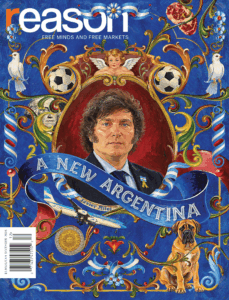
The December 2026 issue of Reason explores Argentine President Javier Milei’s accomplishments and what is yet to be done.
In 1984, Milton and Rose Friedman published a short book called Tyranny of the Status Quo. President Ronald Reagan had been in office for more than three years, Margaret Thatcher had been prime minister for five, and the Friedmans were trying to explain a frustrating phenomenon: Politicians could win elections promising dramatic change, even arrive in office with a genuine mandate, and then discover that the existing machinery of government was unusually good at defending itself.
The Friedmans concluded that reformers had a narrow window of six to nine months to make big changes before bureaucracies adjusted, beneficiaries organized, legislators rediscovered their attachments to the old way of doing things, and the status quo reasserted itself. The obvious implication was that winning an election was not remotely the same thing as winning the day for small government and free markets.
In the United States, libertarians—to say nothing of the Libertarian Party—have had very little luck with even the first step of winning elections. Libertarian ideas have done considerably better than libertarian candidates, influencing tax policy, deregulation, criminal justice reform, school choice, and other areas without generally producing politicians eager to describe themselves as adherents of the whole package or finding voters excited to identify with the label.
A lifelong libertarian might be forgiven for getting a little pessimistic about the possibility of real reform.
Libertarians are accustomed to thinking of ourselves as intellectual insurgents and outsiders. We make arguments about what politicians should stop doing, and then complain when politicians inevitably keep doing those things. Argentine President Javier Milei’s career raises a different prospect: What happens when someone who has spent years attacking the state—someone who has said “my contempt for the state is infinite“—is suddenly responsible for running it?
Milei wins elections while describing himself as an anarcho-capitalist. (While he regularly cites Milton and Rose, he may have more in common with their anarchist son David Friedman.) He won by taking to the airwaves to quote Friedman, Friedrich Hayek, Murray Rothbard, and other free market luminaries. He promised huge cuts, mass firings of government officials, and other radical changes.
In remarks at a September conference co-sponsored by Reason Foundation, the organization that publishes this magazine, Milei described his path from the “cultural battle” into electoral politics. For years, he said, he had been explaining the case for liberty. Then someone put a ballot in front of him and asked where those ideas appeared on it. “Ideas alone aren’t enough,” Milei concluded. If you want to change reality, you have to enter politics; once there, you have to produce results.
Milei moved quickly when first elected, perhaps mindful of the Friedmans’ warning. National spending fell by roughly a quarter in real terms in his first year, and the government began posting surpluses within weeks. Exchange controls were loosened. From 25.5 percent in December 2023, monthly inflation first dipped below 2 percent in mid-2025; after rebounding slightly early this year, it fell to 1.7 percent in August. He cut 10 ministries, dissolved 29 public trust funds, and killed dozens of agencies. The privatization agenda has moved more slowly, in large part because of congressional resistance, but Milei’s government has continued restructuring state enterprises and pushing them toward private ownership where it can.
Nearly three years into the Milei era, Argentina is not fixed. This issue of Reason takes a clear-eyed look at what has been accomplished, and what is yet to be done. Dollarization, central to Milei’s initial campaign, has not happened; Nicolas Cachanosky argues that without a more durable monetary reform, Argentina remains vulnerable to a future reversal. Milei has behaved badly on press freedom, including using criminal complaints against journalists and supporting new restrictions that sit uneasily with his stated commitment to free expression. And yet most of Milei’s impact has been a shocking triumph of libertarian ideals and ideas.
A libertarian in power was always going to encounter constraints that do not exist in books, essays, or panels. There was no doubt libertarian governance would suffer on contact with reality. But two years past the Friedmans’ most optimistic estimate, the window of opportunity for real libertarian change remains open in Argentina.
Milei continues to set the agenda in his country, not merely to survive electoral challenges. His coalition won more than 40 percent of the vote in Argentina’s October 2025 midterms, strengthening his position in Congress and giving him more room to continue his program. As Iván Carrino writes, Milei—perhaps following a playbook from his beloved Rothbard—may now have something libertarians have rarely possessed: the beginnings of a mass constituency for libertarian economic ideas.
The cover of this issue calls it “A New Argentina,” borrowing the title of a song from Evita. The older political promise associated with that phrase in the Broadway musical was Peronist and expansive, built around a larger role for the state in Argentine life. The new version is considerably more peculiar and far more libertarian.
Reason‘s past coverage of Argentina supplies ample reasons for caution, and the Friedmans would remind us that the status quo may still come for Argentina in the end. But for this anarcho-capitalist libertarian, at least, Milei has provided a strong check on the pessimism that comes with being in the minority. He has shown that these ideas can move from books and think tanks onto a ballot, from a ballot into government, and from government into policy without immediately collapsing under the weight of political reality.
Can this experiment be repeated? The United States in 2026 is not Argentina in 2023. Libertarians elsewhere can’t manufacture the kind of crisis Argentina was experiencing, and shouldn’t want to. Argentina also has its own distinctive liberal tradition, including Jorge Luis Borges and Juan Bautista Alberdi. But Milei’s presidency shows that when everything comes together and a window opens, a principled and committed politician can get a surprising amount done.











Leave a comment