

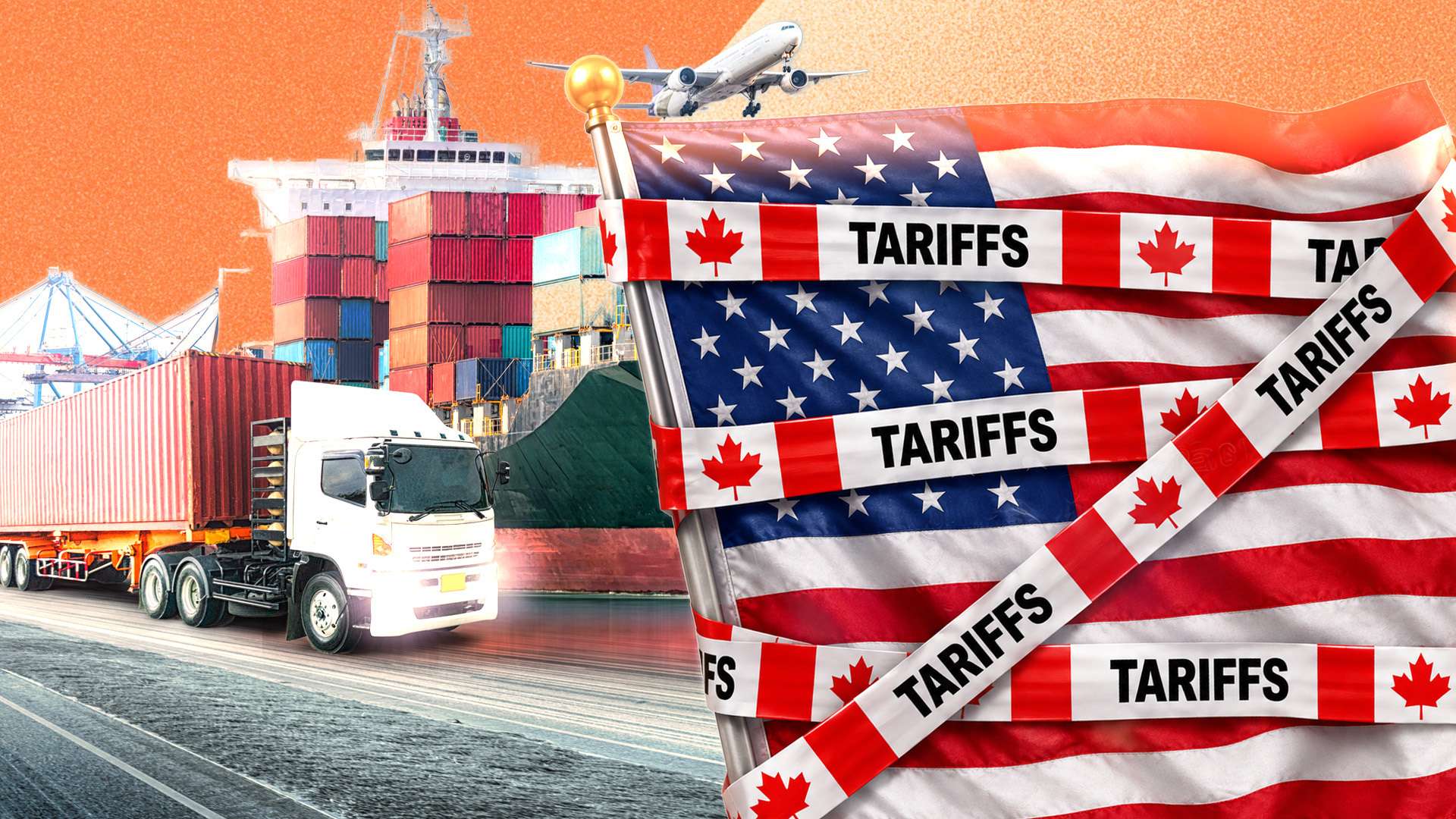
Canada slaps retaliatory tariffs on U.S. goods: Starting today, clothing, cheese, metal, paper products, and wood imports from the United States—totaling roughly $20 billion—will be subject to tariffs in Canada. The new tariffs will also “double the rate of existing tariffs that Canadian businesses pay on imported American steel and aluminum products and affect about 700 products, including aluminum foil, railway locomotives and steel bridges,” reports The New York Times.
The Reason Roundup Newsletter by Liz Wolfe Liz and Reason help you make sense of the day’s news every morning.
These tariffs were enacted by the Canadian government in response to tariffs placed on Canadian goods by U.S. President Donald Trump. “Last spring, I warned that America is trying to break us so that they can own us,” Prime Minister Mark Carney said just weeks ago. “And I promised: ‘That will never, ever happen.’ We are keeping that promise.” When asked by a reporter why his tone seemed so combative, Carney responded: “We were attacked. You’re at war when you get attacked. We got attacked.”
Carney is making good on his threats, issued late last month after negotiations stalled, to retaliate “dollar for dollar” as the U.S. ratchets up tariffs on Canadian products. Polling indicates the prime minister has lots of domestic public support.
U.S. Treasury Secretary Scott Bessent, meanwhile, fired back: “I don’t think you can be in a tit-for-tat with someone who’s 13 times larger than you are.” Trump mused, last Friday, that the U.S. might “end all trade with Canada.”
I must once again tap the sign: “Tariffs not only impose immense economic costs but also fail to achieve their primary policy aims and foster political dysfunction along the way.” This way bad things lie. Why exactly are we souring our relationship with our northern neighbor? Is there any real reason for this?
Quick thread:
So in the last few weeks, we’ve seen the #TNOIIECBAFTATPPAAFPDATW tariff t-shirt up and come to life 1/x pic.twitter.com/79RHtRLx8r— Scott Lincicome (@scottlincicome) May 3, 2018
Scenes from New York: “In the harrowing months that followed the attacks on the World Trade Center, New Yorkers were repeatedly assured that the air around the fallen towers was safe to breathe,” reports The New York Times. “But 10 months later, health officials were still finding evidence of asbestos as much as half a mile away, according to a sample of air quality records being released on Tuesday.” The Mamdani administration is releasing “more than 170,000 pages of air quality reports, contamination records and correspondence among city officials. The records were stored in 68 boxes in a city office, shielded from public view for more than two decades.” Apparently even city officials had misplaced the documents, discovering them only last year. (Hard to know the degree to which that’s true.)
QUICK HITS
- The art of capitalism blaming:
“Capitalism is why people have to work” is very silly thing to say, but it’s part of a grand tradition of blaming literally everything, no matter how absurd, on capitalism.
A short thread: pic.twitter.com/s4LDj81V6H
— Jeremiah Johnson 🌐 (@JeremiahDJohns) September 5, 2026
- “Desalination, turning seawater into water you can drink, transformed a desert into an oasis,” writes Stephen McBride at Rational Optimist Society. “An hour up the road in Dubai the world’s largest desalination facility pumps out enough fresh water to fill 890 Olympic swimming pools every day. Abu Dhabi alone makes close to a tenth of all the desalinated water on the planet. 97% of Earth’s water is ocean you can’t drink. First, you have to take out the salt.…’Desal’ is one of the most under-celebrated successes of our lifetime. The cost of desalinated water has fallen more than 70% since 1990. And it’s changed the fortunes of nations.” The problem is, desalination plants take up a ton of space. What if you don’t have that kind of capacity? Enter two former SpaceXers in Torrance, California, who invented a compact desal technology: “Access weighs 25 pounds and looks like a beer cooler. I lifted it one-handed. You drop a hose in the ocean, press a button, and get six gallons of clean, fresh water every hour.”
- “Iran-backed Houthi militants in Yemen fired drones and missiles at a number of Saudi Arabia’s southern energy facilities Tuesday morning, escalating the fighting on what has become a second front for the kingdom and sending oil prices back toward $100 a barrel,” reports The Wall Street Journal. “Saudi Arabia confirmed the attacks, which the Houthis said targeted facilities in Abha, Najran and Jazan. The strikes hit gas and oil storage facilities including at a power plant in Abha and left the major refinery at Jazan aflame and off line, people familiar with the damage said. Output at Jazan had already been diminished by previous Houthi strikes.”






Leave a comment