
FIFA changed soccer’s rules for Americans—and we love it
 adminUpdated 2 hours Ago5 Mins read
Hello and welcome to another edition of Free Agent! Take a stand for historical accuracy this week.
Let’s talk about soccer this week and how a few subtle rule changes made Americans fall in love with the game and obsess over the World Cup. We’ll close with some thoughts on the Home Run Derby and how MLB is missing out on its full potential.
But first, we’re going to do another one of our “Let’s fix [insert sport here]” surveys, this time focusing on soccer. Feel free to weigh in with any ideas you have for fixing the sport, or just take 10 seconds to vote on the VAR question.
Don’t miss sports coverage from Jason Russell and Reason.
When you think of the typical American soccer hater, they probably have the same few complaints: “The players are all drama queens, they just flop around all the time!”, “There’s so much time wasting because the clock goes on and on,” and “There’s never any scoring, and nobody wants to watch a draw, especially not a scoreless one.”
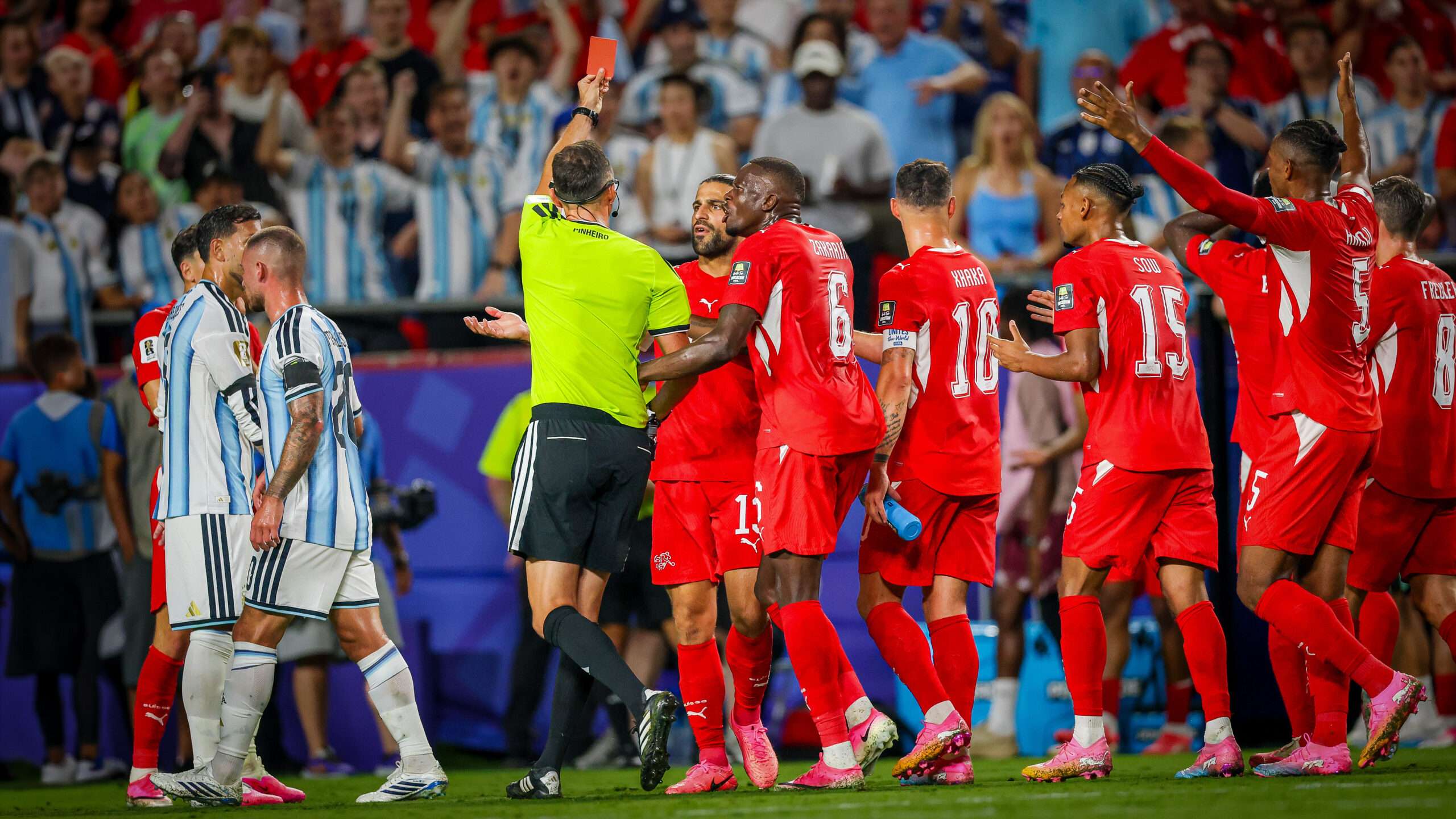
FIFA, it seems, heard these complaints and did its best to fix them before the 2026 World Cup came to America. As far as I can tell, it’s worked. Just look at this post from a popular golf account:
So just now in the World Cup, a Swiss player got ejected from the match for flopping.
Amazing!
If this had been enacted in the NBA, LeBron and Harden may not have finished a game. 😂
pic.twitter.com/zmf72xXzP3— Rick Golfs (@Top100Rick) July 12, 2026
(That’s a stark contrast in attitude from this popular soccer journalist.)
Referees have always been allowed to give out yellow cards for flopping (or “simulation,” as the rulebook calls it). But now the video-assistant referee (VAR) can help the referee spot a flop in certain situations.
This goes hand-in-hand with one of several rule changes to cut down on time-wasting. If anyone gets hurt badly enough that they call for the medics to come on the field to treat them, they have to leave the field for at least 1 minute (there are several exceptions, though). While previously you might have a player flop down and call for medical treatment to waste time late in a game, now a player doing that might get a yellow card for flopping and would have to put his team at a disadvantage for a minute because the medics came on. Players also have to leave the field within 10 seconds if they’re getting substituted out of the game (previously they might stroll off the field slowly for 30 seconds or more), and referees can hurry a goal kick or throw-in along with a five-second timer if they sense time-wasting is going on.
More time in play probably isn’t why this World Cup has more goals, but it doesn’t hurt either. The tournament is averaging just under three goals per game—the most in over 50 years, according to beIN Sports. The group stage had 20 percent more goals per game than the 2022 group stage.
As for draws, FIFA wasn’t technically trying to cut down on them. But thanks to expansion, the tournament went from 15 knockout games to 31, meaning there are twice as many games with the can’t-miss excitement of penalty kicks looming at the end of any match that’s still tied. There were seven scoreless draws in the group stage (out of 72 matches), but at least two of those were superbly exciting even with the lack of goals: Spain “upset” by Cape Verde, and Colombia’s exciting match against Portugal.
Maybe it’s just the glow of the World Cup being hosted (mostly) in America, or maybe the changes have worked. In any case, Americans are watching. The TV ratings are setting records and fans are packing stadiums in spite of ticket prices. (I’m excited to see how many matches like this show up on the list of the year’s most-viewed TV episodes.)
Of course, there are still plenty of soccer haters complaining about the VAR and the offside rule. But complaining about these things at least implies the hater is watching.
With all those changes in mind, let’s spend even more time fixing soccer.
Have a great idea for changing the World Cup format? I want to hear it. Got strong feelings about how club soccer leagues and competitions are operating? Let’s talk about it. Do you have a crazy rule change that will revolutionize the game? Don’t pass it back to the goalie, send it my way. Love VAR, or hate it? Boy, do I have an oversimplified survey question for you.
All the questions are optional, so feel free to sound off on one and leave the others blank. Spend as much or as little time as you want on it. Again, click here for the survey link. I’ll plan to review everyone’s ideas next week after the World Cup final.
Unfortunately, your favorite All-Star Game sucks, as I wrote last year. Like most all-star festivities in other sports, MLB is experimenting with the Home Run Derby’s format—again—in an attempt to boost viewership (the move from ESPN to Netflix this year was perhaps not helpful). Past iterations involved time limits, pitch limits, or “out” limits, but they now involve a maximum of 20 swings in the first round, then 15 swings each in the semifinals and finals (a home run on the last swing allowed the player to keep going until they failed, although this only happened twice on Monday night).
Unlike most other supplementary all-star events, the Home Run Derby has more than 40 years of history—MLB just isn’t utilizing that history very well.
Although its roots are a 1960 TV show, the event officially started in 1985. In an ideal world, this year’s combatants wouldn’t just be competing against each other; they’d be competing against history and trying to out-bomb records set by the event’s greats in past decades, like Darryl Strawberry in the ’80s, Ken Griffey Jr. in the ’90s, Bobby Abreu in the 2000s, and so on. But because the event’s format has changed at least seven times in its history, it’s now basically impossible to compare derby sluggers across generations.
After four decades of experimenting, MLB should be able to figure out what the event’s best format is—and stick with it for the next four decades. Let’s see if the greats of the 2030s and 2040s can beat the marks set this year by champion Jordan Walker of the Cardinals. Better yet, add a short qualifying event so fans of every team feel like they have some skin in the game (but give the host city’s team a guaranteed representative in the final eight). I’m fairly ambivalent about what the best format is when it comes to outs vs. time vs. swings—just pick one and stick with it. All we need is dingers.
I tuned into this year’s event as background noise to put on while working on this newsletter. (Granted, a Tigers player competing would have raised my interest.) It was entertaining enough watching Walker hit six home runs in a row to play the villain and upset the home team’s Kyle Schwarber in the final—but it still had all the feel of a cool one-off event. If you put history on the line, you make it a can’t-miss event every year to see if someone can turn a somewhat memorable night into a legendary one.
I am not rooting for Argentina to win the World Cup (apologies to Reason‘s resident Argentine, Agustina). But the placement of this shot to take the lead was just ridiculously good—almost as good as Maxi Rodriguez’s goal in the 2006 World Cup, another Argentine goal to take the lead in extra time.
A SENSATIONAL GOAL FROM JULIÁN ALVAREZ TO PUT ARGENTINA IN FRONT IN EXTRA TIME 🇦🇷 pic.twitter.com/J3Ql16XwX3
— FOX Sports (@FOXSports) July 12, 2026
That’s all for this week. Who needs Sunday’s World Cup final when you could be watching the real event of the weekend: the final day of the Cape Cod Bluewater Classic of the Sport Fishing Championship.










Leave a comment