
J.D. Vance’s interest in Huey Long should worry conservatives
 adminUpdated 2 hours Ago3 Mins read
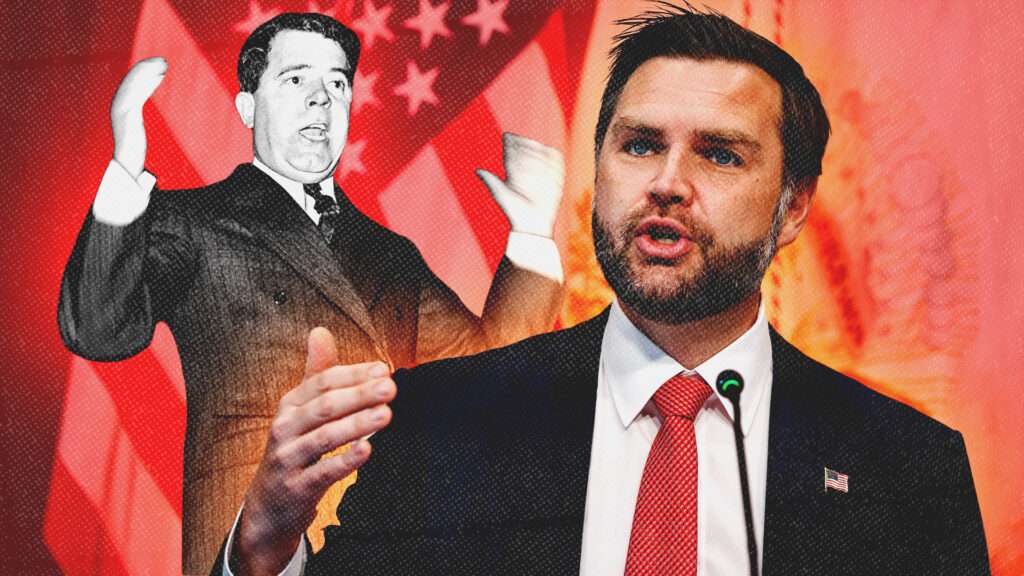
As a governor and senator, Huey Long is best remembered for his radical proposals to redistribute wealth by force and for criticizing President Franklin Delano Roosevelt’s “New Deal” as not expansive or progressive enough.
So when Vice President J.D. Vance says out loud that he finds Long “great” and “interesting,” that’s worth keeping in mind.
While speaking in Ohio last week, Vance invoked Long’s famous “Every Man A King” slogan and hailed Long as a “great Southern populist” who was “an interesting guy; kind of a crazy guy.”
“But no man is a king if their castle is under siege by criminals,” Vance continued, “No man is a king if they can’t take their family out to dinner without being mugged or having their car jacked.”
The moment is illustrative both because of Vance’s choice to invoke Long by name—this was a deliberate choice made in a prewritten speech, not some off-the-cuff remark—and for how the vice president seems to have misunderstood the speech he was referencing.
Indeed, Long’s “every man a king” platform had nothing to do with locking up criminals or more restrictive immigration enforcement, as Vance suggested in the speech. It was, instead, a direct call for a more powerful federal government to seize and redistribute wealth.
“You must keep the wealth of the country scattered, and you must limit the amount that any one man can own,” Long said. To accomplish that goal, Long advocated for limiting individuals to owning no more than $50 million—though he admitted that “it may be necessary that we limit it to less.”
That’s the equivalent of about $1.2 billion today. Effectively, Long was calling for a populist uprising against the billionaires of his time. He was quite literal about it. “Our taxation is going to be to take the billion-dollar fortunes and strip them down to frying size,” he promised.
And that’s not all. The rest of the “every man a king” program called for loan forgiveness and a limit on the number of hours people worked. It is a speech and a political platform that, aside from a few bits of outdated language here and there, sounds like what you’d expect from the likes of Sen. Bernie Sanders (I–Vt.), New York City Mayor Zohran Mamdani, or the Democratic Socialists of America.
What is it, one might wonder, that Vance finds so interesting about Long?
In fairness, Vance did add that Long was “kind of a crazy guy.” And the vice president was not saying that Republicans ought to embrace Long’s economic views or copy his policy platform. Vance’s point seems to be that abstract ideas like freedom and rights can be undermined by material insecurity—and even though the context is quite different, that was certainly a fundamental premise of Long’s call for redistribution of wealth.
But this is also a telling wink.
Long may have wanted the federal government to decide how much wealth Americans could hold, but he had less strict views about the accumulation of political power. He understood, as Vance seemingly does too, that populism is a means to an end, and the end is usually a more muscular government. Lawrence Dennis, an outright American fascist, said that Long was “the nearest approach to a national fascist leader” that the U.S. had ever seen.
Vance has no trouble cozying up to authoritarians or espousing illiberal views about political power.
Lately, he has been making his progressive and authoritarian economic views increasingly clear. In a recent interview with Michael Knowles of The Daily Wire, Vance defended President Donald Trump’s idea of seizing AI companies’ profits, then proceeded to outline a vision for the future in which the Republican Party shuns the economic ideas of Milton Friedman.
“Vance understands better than Trump that such a proposal contradicts long-held GOP economic dogma, and that’s precisely what he likes about it. He likes that it’s kind of socialist,” wrote Reason‘s Robby Soave at the time.
It was perhaps inevitable that Vance’s mixture of illiberal political views and populist economics would land him in the vicinity of the “Kingfish.” By invoking Long, Vance has offered a clarifying moment. Long represents almost everything the American right once warned against in the name of limited government and constitutional liberty.
The fact that Vance can’t stand Friedman but finds Long to be an “interesting” figure speaks volumes—and should be a major red flag for his future political aspirations.










Leave a comment