
My home state is set to hand a breakthrough to the German far right. It’s a disaster decades in the making | Marcus Böick
 adminUpdated 2 hours Ago4 Mins read
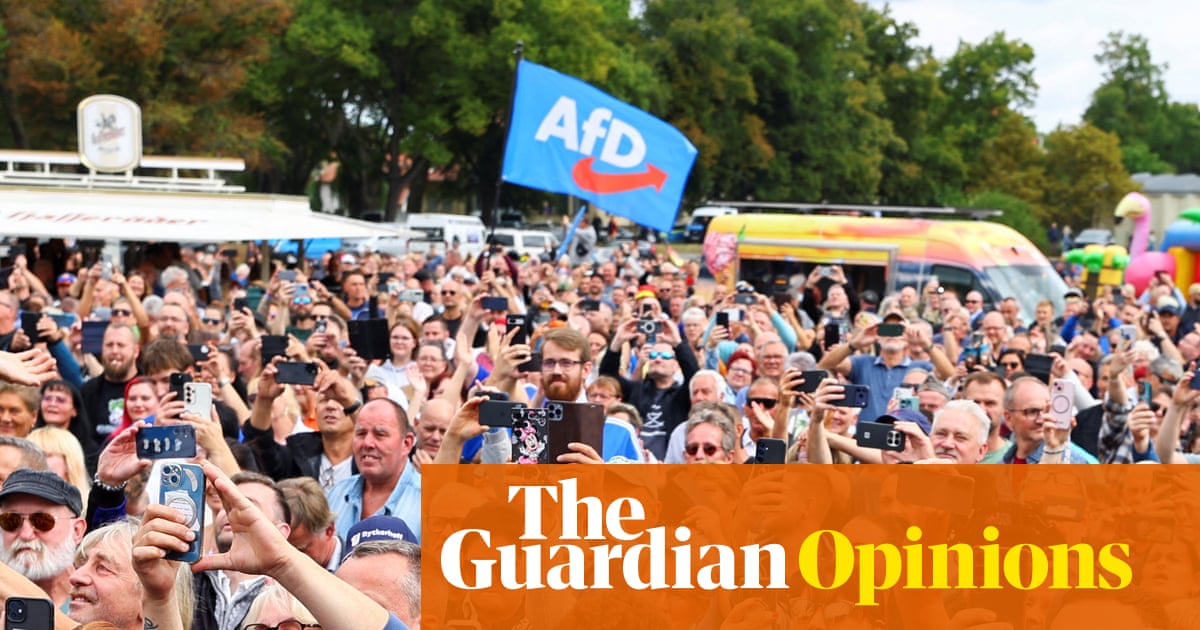
It was in the summer of 2004 that I stopped understanding my own people. I was standing on a sweltering market square in Aschersleben, the town where I was born, picturesquely situated on the northern edge of the Harz mountains. A large crowd of angry people had gathered in front of a stage to protest about the welfare reforms (or, as many saw them, welfare cuts) introduced by the Social Democratic-Green coalition government under chancellor Gerhard Schröder. They chanted “We are the people!”, waved handpainted placards and seemed utterly beside themselves.
I had gone to secondary school nearby, volunteered at the local hospital and interned at the local newspaper: I knew this place. And yet I found myself bewildered. What, exactly, did these deeply aggrieved people want – standing on a freshly renovated, almost idyllic market square? Weren’t things going reasonably well for them? Where did this burning resentment toward the west come from? Wasn’t the east-west divide supposed to be disappearing by now?
More than two decades later, similar questions can once again be asked.
Eastern Germany is facing a blue wave – or rather, a blue flood. In the state election in Saxony-Anhalt on 6 September, the far right Alternative für Deutschland (AfD), whose party colour is blue, is almost certain to emerge as the largest party. Opinion polls consistently place the AfD above 40%, while the governing Christian Democrats (CDU) trail on around 23%. The Left party, once dominant in the east, has fallen to just 13%, while the Social Democrats (SPD) are struggling to clear the 5% electoral threshold.
Should only three or four parties enter parliament, the way would be open for Germany’s first-ever state government led solely by the AfD. The established parties would find themselves stranded on the other side of the much-invoked political “firewall” against cooperation with the far right – and, for the first time since 1945, a party containing openly extremist factions would hold governmental power in a German federal state.
The AfD would exercise considerable authority over policing, the judiciary, education and cultural affairs – areas that the party seeks fundamentally to “re-nationalise”, for example by reducing funding for memorial sites commemorating Nazi crimes and revising school curriculums to place greater emphasis on what it regards as the achievements of German history.
For me – and, I suspect, for many East Germans who have left their homeland – the rise of these developments did not come as such a surprise. During my infrequent visits home over the past 10 years, it was palpable that something fundamental was shifting.
When we celebrated the milestone birthday of an old school friend in early 2024, a group of longtime friends flew in to spend a cold January weekend together in Hettstedt. Yet while we cheerfully reminisced about old times, the friend’s family, whom I had always remembered as lively and eager to debate, just sat by, saying almost nothing. I was perplexed. Only later was I told that my friend’s mother – the heart of the family – had forbidden any political discussion. She feared that the guests who had come from afar would be deeply unsettled by how openly people now voiced views that had once been considered taboo.
Saxony-Anhalt has always been a state with a difficult identity. In spite of an extraordinary cultural heritage – it is the home of Martin Luther, George Frideric Händel, Friedrich Nietzsche and the Bauhaus – it lacks a clearly defined regional character. Assembled from various territories of Prussia after its dissolution in 1947, it was abolished during the socialist German Democratic Republic and then re-established after reunification in 1990.
Home to almost 3 million inhabitants at the time, Saxony-Anhalt entered the new era with tremendous optimism – only to suffer a brutal crash landing in the spring of 1991. East Germany’s state-owned industries were to be rapidly privatised by the Treuhand agency in an attempt to make them competitive in a market economy. Yet after decades of central planning and chronic shortages, the socialist combines were scarcely capable of surviving the massive shock produced by the economic and monetary union. Instead of the “flourishing landscapes” that chancellor Helmut Kohl had boldly promised, the whole region entered an unprecedented downward spiral.
The metalworking and chemical industries of southern Saxony-Anhalt were hit particularly hard. During the spring of 1991, hundreds of thousands lost their jobs. Over the rest of the decade, many areas outside the main cities experienced industrial dismantling, mass unemployment and large-scale outmigration.
Younger people, particularly well qualified women, began leaving the region. For my own generation, graduating around the turn of the millennium, moving away appeared to be the only viable path. At the same time, the state steadily withdrew from shrinking rural areas, closing schools and hospitals, relocating courts and police stations. Even the democratic political parties, always much less firmly rooted in eastern than in western Germany, became increasingly invisible.
after newsletter promotion
The echoes of these immense transformations have grown louder once again over the past 35 years. On average, East Germans remain considerably poorer than their western counterparts. They possess significantly less wealth, inherit much less and often face markedly weaker career prospects. A lingering feeling of being “second-class citizens” has become deeply entrenched, extending even to generations born long after German reunification.
I can understand these feelings, and I can understand how the AfD has channelled this pervasive sense of abandonment: through social media, local WhatsApp groups, football clubs and neighbourhood pubs. The anger no longer gathers helplessly on the town square; instead, it has found new energy and vastly greater reach in the digital sphere. And in the polling stations.
What I can’t understand is that the people I grew up among are failing to see how hollow the AfD’s promises are. The slogans this party offers are not solutions. Many of the measures it advocates would only make a grim situation worse. How are businesses or hospitals supposed to recruit the skilled workers they urgently need if the main party simultaneously calls for large-scale “remigration”? How can anyone develop a positive vision of the future while at the same time expressing admiration for the Nazi reich or the GDR? It seems a case of suicide out of fear of death, as Bismarck is supposed to have said.
Whether on a sun-drenched market square in the summer of 2004 or at a wintry family celebration in 2024, one thing became unmistakably clear to me: there are neither simple answers nor quick solutions. In Saxony-Anhalt, as elsewhere, the task will be to give people with sometimes very different views and values a genuine sense that they are being included on a shared path toward a common future.





Leave a comment