

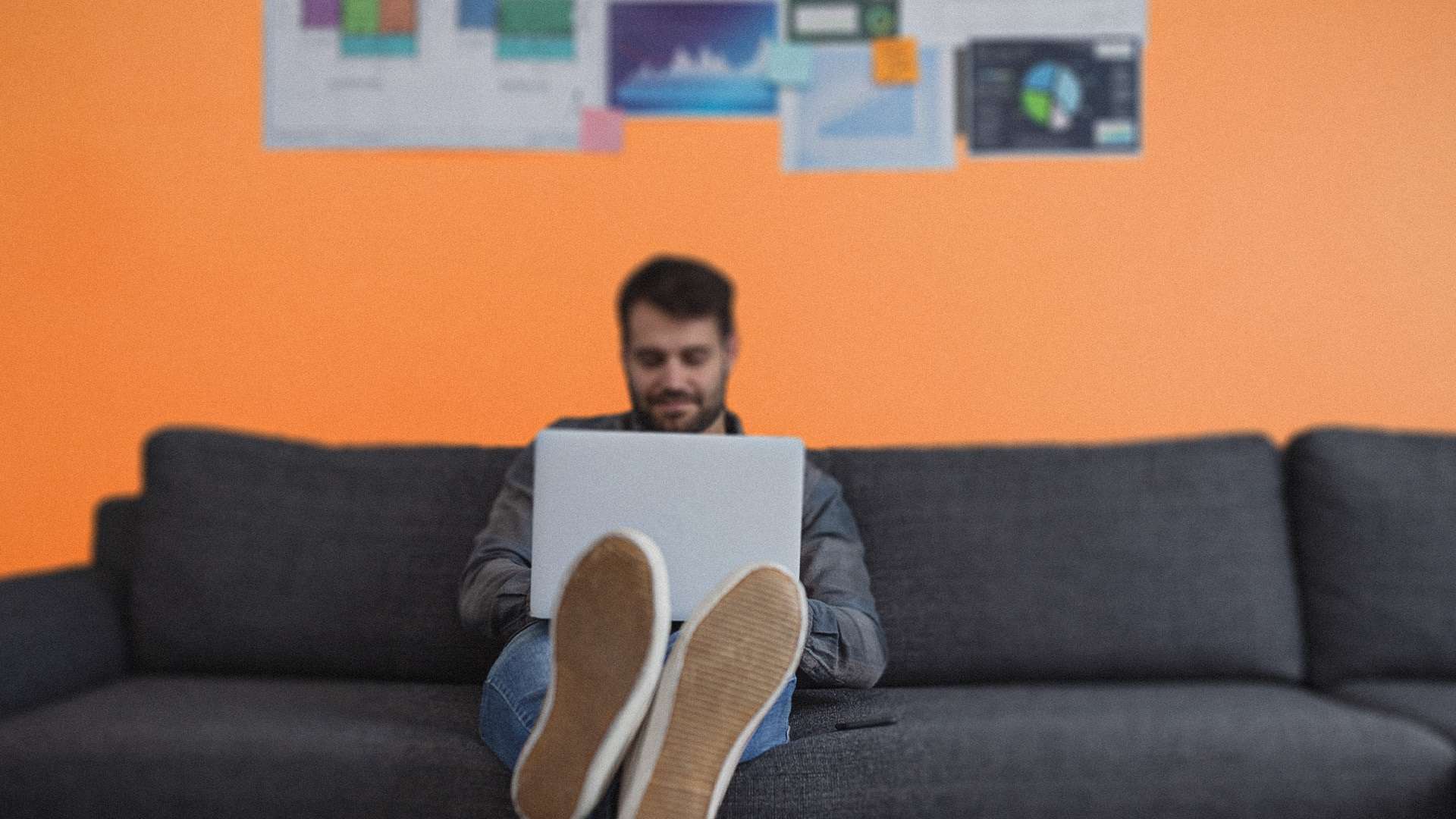
People like working from home. It lets us avoid commutes. It lets us live closer to family. It seems especially good for the parents of young children, and it could even boost birth rates.
This seems like an indisputable tech success story. Thanks to a plethora of modern technologies and applications—the internet, smartphones, VPNs, video calls, instant messaging platforms like Slack, cloud-based software and documents, and so on—remote work has become a possibility for more people than ever, and that’s a good thing.
But are we all kidding ourselves about the benefits of remote work? Are we suffering from false consciousness? Do we only think we like it while it’s actually making us miserable somehow?
You are reading Sex & Tech, from Elizabeth Nolan Brown. Get more of Elizabeth’s sex, tech, bodily autonomy, law, and online culture coverage.
That’s what labor economists Emma Harrington and Natalia Emanuel suggest in a very frustrating New York Times opinion piece based on a very frustrating study published in Science. “Our estimates…indicate that remote work explains a third of the deterioration in mental health between 2011 and 2024,” write Harrington and Emanuel, the authors of a forthcoming book about the benefits of office life.
Their claim—that remote work is responsible for a full third of mental health declines over the past 14 years—is pretty wild, and it immediately sets off some alarm bells. So let’s look a little closer at how this study was conducted and what it might actually mean.
‘Remotable’ workers, not remote workers
Harrington and Emanuel’s study didn’t actually compare mental health measurements between remote and non-remote workers. It measured the differences between groups they refer to as “remotable” and “nonremotable”—those in jobs capable of being done remotely and those in jobs it’s not usually possible to do outside of a job site.
“Remotable” workers weren’t necessarily working remotely, and “nonremotable” workers weren’t definitively non-remote.
Without actually comparing remote and non-remote workers, it would seem that they’re simply capturing differences between people in different types of professions. In other words, this study might tell us about how mental health has declined more in people with desk jobs than among those doing service jobs, medical work, or manual labor. But it doesn’t really tell us about the effect of remote work per se.
Those in “remotable” jobs did work from home more than those in the other category, according to the study’s figures. Roughly 31 percent of workdays in the former group were fully remote by 2024, compared to around 9 percent of the workdays of those in jobs classified as non-remotable. That’s a real difference, but not as large a gap as you might expect from the terms being used, which reinforces the possibility that we might be looking at something other than the effects of working from home.
Remote work, or the pandemic?
The researchers here looked at data spanning 2011 through 2024, excluding 2020 and 2021. But the shifts causing alarm happened mainly in 2022–2024.
“With fewer social encounters, workers in jobs that can be remote saw steeper increases in distress, mental health visits and prescriptions for antidepressants than other workers did,” Harrington and Emanuel write in the Times. “This increase in depression…began in 2020 and has not abated, which points to remote work as the driving force.”
Hmmm, I can think of something else which began in 2020 and might have caused an increase in distressed feelings. If it hit remote workers (or “remotable” workers) harder, that could be in part because pandemic-era socializing was often limited to work, which meant many remote workers didn’t see anybody while at least “essential workers” got some social interaction. In addition, being potentially exposed to COVID-19 regularly through one’s job may have helped decrease panic about the virus generally and/or increase a propensity to see others outside of work, since exposure was already possible anyway. (Put another way, people in remote jobs, capable of locking themselves up inside during the day, may have been more likely to try to stay hermetically sealed all of the time.)
Or, again, maybe we’re just looking at how people employed in different types of jobs—who likely differ in socioeconomic status and many other ways, not just in their occupations—reacted to the pandemic and its aftermath. Perhaps we’re looking at differences in post-pandemic economic prospects, or something else.
The disparities have still “not abated,” they tell us— but, remember, the mental health data they looked at only goes through 2024. It’s possible that lingering effects of the pandemic hadn’t worn off yet then but have come around by now or will come around soon. It’s also possible that various costs of the pandemic—missed socializing, missed opportunities to meet a partner, declines in physical fitness, etc.—hit “remotable” workers harder and the second-order effects of these things will take a long time to remedy.
I just don’t think we can look at mental health shifts in the few years following the peak pandemic years and conclude anything about work arrangements generally. Conclusions drawn from during this period just don’t necessarily carry over to normal years.
(Something else that could explain more-recent anxiety among “remotable” workers is artificial intelligence. People in jobs that can be done remotely may have more cause to worry about AI displacing them. The study authors say they have controlled for this, somehow.)
Slightly More Nervous
Even if we accept the general premise of this study, we may want to temper our alarm, considering that the effect sizes we’re seeing are quite minor.
The main measure of psychological distress the researchers used was something called the 6-point Kessler Psychological Distress Scale (K-6), which included six questions related to anxiety and depression.
Scores increased for both remotable and nonremotable workers from 2011 through 2024, but they increased more for those in the remotable job group—though by less than 0.1 standard deviations relative to their nonremotable counterparts, which is a very small effect. For context, the authors later describe a standard deviation double that size deviation (0.21) as “approximately equal to increasing the frequency of one of the K-6 components of distress by one category, such as going from being nervous some of the time to nervous most of the time.”
It should also be noted that the nonremotable group scored higher on the distress scale both before and after the pandemic. So this study did not find that remotable workers have worse mental health overall. It found that the remotable group—which started out with lower scores—nearly converged with the non-remotable job group between 2022 and 2024.
Anecdote Time
I’d like to hit pause on critiquing the study directly to write for a moment about my own experiences and give a resolute no, thank you (or insert your choice of a stronger-worded rejection here) to what this study is selling. I have worked remotely, off and on, since 2009 and found it immensely beneficial. If remote work makes you feel bad, perhaps you’re doing it wrong.
“On some days, we wouldn’t venture outside or speak face-to-face with another human,” Harrington and Emanuel write of their own time working remotely.
Certainly, that’s some people’s experience. But it doesn’t have to be.
I first started working from home when I was 27 and employed as an AARP web editor. I’d been going into the group’s office in D.C.’s Chinatown for two years and wanted to move to New York City, where my then-boyfriend lived. He worked remotely too. Though we didn’t live together at first, we were together most days, working from his shared loft or my shared apartment. A lot of our roommates were around during the days too—either artists or students or unemployed.
Far from failing to see other human beings, I was lucky if I ever got alone time.
I started going back into an office again in 2014, when I started working for Reason. This arrangement lasted until the pandemic. By the time the office reopened, I had moved to Cincinnati. Not long after, I had my first son, followed less than two years later by another.
Working from home these days is much different than when I was in my 20s. But it’s no less welcome, and no more isolating. My husband also works from home, so even on days when it’s just us there’s always someone else around. And most days, my kids are also home, watched by a relative. Once again, it’s rare for me ever to be in my house alone.
For me, working from home has been a huge blessing. During my AARP years—when I could complete my work and then some in the time I was allotted—I could spend the extra time working with friends on creative projects and household endeavors, instead of sitting at a desk and pretending to be busy. Working from home also allowed me to be in the city where I wanted to be at that time, instead of the city where company headquarters were.
These days, working remotely means I get to spend more time with my kids. We have lunch together most days when they’re not in school. I can be with them in morning and evening hours that might otherwise be devoted to commuting. And throughout the day, they know I’m just a hallway away if they really need me. Working from home also means that I get to live near my large Cincinnati family (and, as a bonus, never worry about wearing office clothes or packing a lunch).
Besides, I am someone who works better from home than I do in an office. And while there are downsides to ditching office life—I do miss my colleagues and the weird, interesting, inspiration-provoking office chatter—I think the benefits outweigh the negatives.
I tell you all this to challenge the idea that remote work must necessarily be isolating. Obviously, my living situations are not everyone’s. But they’re not wildly unique or unobtainable either. Plenty of 20-somethings live with roommates and could find some that also work from home. Plenty of people with small children rely on family or other informal childcare arrangements in their own homes. Certainly, anyone could find a work buddy to meet at a coffee shop or find a third space to do some of their work.
Even if remote work is sometimes experienced as isolating, it doesn’t have to be.
Back to the Study
It turns out that my personal experience actually aligns nicely with the remote work study, which found no significant difference in mental health effects among remotable or nonremotable workers when they lived with others.
“Among those cohabiting, mental distress rose for people in both remotable and nonremotable jobs in tandem,” the paper states. “There was no statistically significant differential increase in mental distress for those in remotable jobs.”
This finding suggests that even if working from home can lead to isolation and distress, there are ways to mitigate that.
“For those living alone, before the pandemic, mental health was worse among those in nonremotable jobs, whereas afterward it was worse among those in remotable jobs,” the paper states, noting that the reversal represents a 0.21 standard deviation “relative increase on the K-6 distress scale for those in remotable jobs.”
That’s not nothing, but it’s a fairly small difference—and, again, one we can’t necessarily attribute just to remote work (even if we assume that the hastened decline was concentrated among those actually working from home and not just “remotable”). Some people living alone may be just out of a relationship, or newly moved to an unfamiliar city, and this—not remote work—could drive some negative feelings. Perhaps the kind of people who live alone are also by temperament more likely to have been sensitive to the effects of the pandemic and its aftershocks.
The fact that the study’s major cautionary findings were concentrated among those living alone really introduces a whole new wrench in the alleged cause/effect theory, since people living alone—by choice or not—are likely different in various significant ways from those who don’t live alone. Any of these differences could drive the varying mental health results, rather than or in tandem with remote work.
Even more suspect: The study seems to have counted people living with non-family roommates as living alone, at least for some measures. “Our primary definition distinguishes between those who live with their partner and/or children and those who do not,” says the paper. “For ease of exposition, we refer to the latter as living alone.”
People with non-family roommates—counted here as living alone—are likely to be younger than those living with spouses and kids, and perhaps different in other ways. So this just introduces more variables other than remote work that could explain why one group had beyond-typical increases in mental health decline.
We’ve gone from Mental health declines are being caused by remote work! to We saw slight post-pandemic differences in people who could potentially work from home and don’t live with a spouse or kids.
What Now?
In the Times piece, Harrington and Emanuel write that they don’t necessarily think everyone should return to physical offices, merely that “employees and companies should make a greater effort to prioritize face-to-face time with colleagues.” Then again, the Science paper says this: “Because individuals may struggle to overcome isolating work arrangements on their own, firm policies—and the government regulations shaping them—play a key role.”
Whatever their intentions, I’m afraid that—at a time when many businesses are reversing pandemic-area remote work policies and ordering everyone back to the office—their paper could serve as further justification for ending flexible work policies. And that could be devastating for people who built lives far from their company’s headquarters, on the assumption that remote work would not be a problem.
Ending remote work could definitely make life tougher for parents of younger children, who might be available for mostly-normal hours but need flexibility for school drop-offs and pickups and might have to pay for extra hours of childcare to accommodate time spent getting ready for work and commuting. And because mothers still do more childcare, this comes down especially hard on women. This is why I consider flexible work arrangements an important feminist issue. Being allowed to work from home—entirely, or at least sometimes—makes it easier for women to both work full time and raise children. It means less stressed moms who get to spend more time with their kids.
Of course, companies shouldn’t allow remote work by people who can’t do good work remotely. And remote work isn’t for everyone—though a lot of people desire it. “In 2024, nearly 80 percent of workers said they would be happiest if they could work remotely,” the Times article states.
There’s something weirdly paternalistic about the idea that while people say they like working from home and want to work from home, they’re secretly being harmed by it and we need regulators and HR reps to intervene. If a person wants to work from home, and their bosses and colleagues are satisfied with their remote performance, that’s all that should matter—not whether a convoluted economic study says they might be ever-so-slightly sadder in the long term if not ordered back into a cubicle.
In the News
Federal court urges Trump administration to reconsider abortion pill prescribing rules. Abortion-pill regulations imposed by the Food and Drug Administration are “unlawful,” a federal court said Thursday. These include regulations requiring mifepristone prescribers to be certified (and thereby register with drug manufacturers), a requirement that pharmacies get a special certification to dispense the pill, and a rule requiring patients to sign a form acknowledging they’re aware of potential risks.
“Mifepristone is incredibly safe, yet it faces restrictions that aren’t even required for high-risk medications, like opioids,” said Linda Goldstein, senior counsel at the Center for Reproductive Rights. “That’s why we asked the court to remove three medically unnecessary restrictions, which make abortion pills harder to access nationwide.”
Judge Robert S. Ballou said the three rejected restrictions had not been reasonably justified, calling the decision to impose them “arbitrary and capricious.”
Ballou “ordered the Trump administration to reconsider the rules, but did not void them and did not find that the FDA (Food and Drug Administration) had acted illegally in principle in trying to impose safety restrictions,” reports Agence France-Presse. “The case is separate from another currently in the Fifth Circuit, where the Republican-led state of Louisiana is asking the FDA to reimpose a ban on patients receiving mifepristone by mail or through pharmacies after a virtual visit with a provider.”
On Substack
Who needs church when you’ve got Etsy witches? At Persuasion, Leonora Barclay—who had her tarot read by someone she found through the online marketplace Etsy—looks at the rise of “e-spirituality”:
Around 80% of young people today identify as spiritual, and many of them are flocking to places like Etsy. Women, in particular, are increasingly looking at non-traditional ways to explore their spiritual side….
My Instagram feed showcases a number of “witches” selling their wares, including love spells, many of which are far cheaper than paying for a dating app. Astrology has likewise taken off, with a staggering 63% of young Americans reporting that consulting the stars has positively impacted their careers. Spirituality is lucrative, too. By 2031, spending on astrology products is projected to rise to $22.8 billion—$10 billion more than in 2021.
I can’t comprehend any of this—I’m pretty sure I don’t have a “spiritual” bone in my body. But lest anyone starts lamenting the state of young women today or blaming iPhones or any other modern invention, let’s keep in mind that the spiritualists and Theosophists of late 19th and early 20th centuries were convinced they could commune with the dead through seances, allong with all sorts of other woo, and that this was a really big phenomenon embraced by people of all ages.
Read This Thread
🚨Fifth Circuit ruled yesterday on Texas’s SCOPE Act (HB 18).
Part of the lawsuit challenged the age verification requirement of the SCOPE Act. Yesterday’s ruling said the challenge to the age-verification requirement is now “foreclosed” by precedent.
The court cited the… pic.twitter.com/VlCU9NLgiy
— Julie Barrett (@juliecbarrett) July 25, 2026
More Sex & Tech
• “Is it illegal to make your data self-destruct in the hands of the authority figure trying to snoop around on your phone, or are you within your rights to make that happen?” asks Gizmodo. The question—spawned by Sam Tunick’s allegedly using this trick when his phone was seized by U.S. Customs and Border Patrol—is now the subject of a federal criminal case.
• A 15-year-old suing big tech companies over alleged addiction dropped his case against Meta, after settling with TikTok, Snapchat, and YouTube. “The claims never held up, and this outcome makes clear that we will not back away from defending ourselves against baseless lawsuits,” a Meta spokesperson told the BBC.
• Nick Gillespie delves into—and aptly criticizes—a lawsuit filed by a Florida man, Scott Winters, against ChatGPT after the artificial intelligence system allegedly game him bad health information.
• “Open AI said that its artificial intelligence models were behind an ‘unprecedented cyber incident’ that affected the open-source developer platform Hugging Face” after a not-yet-released model, GPT-5.6 Sol, “escaped a sandboxed testing environment,” reports CNBC.
• “Many of the ways the government gets our data never cross a judge’s desk,” notes Nicole Shekhovtsova, a tech policy analyst at Reason Foundation (the nonprofit that publishes Reason). “The strongest privacy protection, it turns out, isn’t a warrant: It’s when our data is never collected into a single vault. Yet lawmakers keep forcing companies to build them.”
• The App Store Freedom Act is pretty bad for freedom, suggests Jack Nicastro.
• A mathematician seemingly used AI to disprove an 87-year-old math problem.
• “A bipartisan group of senators has introduced the Securing Enforcement of Americans’ Right to Competition at Home (SEARCH) Act, which would prohibit dominant search engines from using certain default distribution agreements or favoring their own services over competitors in search results,” reports Sam Raus.








Leave a comment