
Our Friend with the “Attractive, Busty Jewess” Problem Drops Case Against Harvard Rather Than Naming Himself
 adminUpdated 1 hour Ago2 Mins read
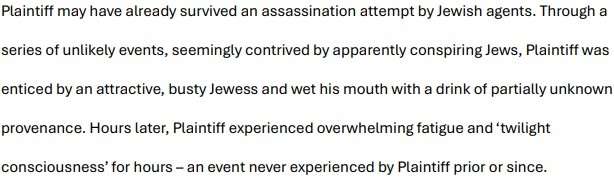
Readers of the blog may recall a certain John Doe who is suing Penn, Dartmouth, Harvard, and Berkeley for alleged discrimination; he argues, among other things, that “in service of their goal to [exterminate] or enslave all non-Jews, the Jewish supremacists discriminate [against] non-Jewish whites,” including him. He also seeks to proceed under a pseudonym, partly because he claims a fear of physical harm:
So far, courts have rejected his pseudonymity claim, and he’s appealing the decision in his Penn case to the Third Circuit.
But in the meantime, what to do about his other cases? Well, in the Harvard case, he asked Judge Allison Burroughs, who had denied his pseudonymity motion, to stay that case pending appeal. No, the judge held on May 20:
Plaintiff … requests a stay of his disclosure requirements pending interlocutory appeal of the Court’s denial of his motion to proceed under a pseudonym. “In determining whether to grant a stay, courts consider: (1) [W]hether the stay applicant has made a strong showing that [it] is likely to succeed on the merits; (2) whether the applicant will be irreparably injured absent a stay; (3) whether issuance of the stay will substantially injure the other parties interested in the proceeding; and (4) where the public interest lies.” The first two factors are most important.
Plaintiff has made essentially no showing, certainly not a strong showing, that he will succeed on the merits, and he has provided no credible, non-speculative argument that he will be irreparably injured absent a stay. Defendants have taken no stance as to whether a stay would cause them injury, and the Court presumes that it would not. Finally, as explained above, the public has a strong interest in transparency, weighing against Plaintiff’s request for a stay…. “[T]he people have a right to know who is using their courts.” … Accordingly, Plaintiff’s request for a stay is DENIED. Plaintiff is directed to file a notice of his legal name and address no later than June 2, 2026.
He then sought a stay pending the appeal of his Penn case, but the judge again said no (on July 15):
Plaintiff’s motion to stay this proceeding pending resolution of his appeal in the Third Circuit is DENIED. While “the power to stay proceedings is incidental to the power inherent in every court to control the disposition of the causes on its docket with economy of time and effort,” the Court finds that a stay is not warranted here for the reasons set forth in the Court’s May 20, 2026 order.
Though a trial court may stay an action pending the resolution of independent proceedings, this Court is not bound by whatever resolution Plaintiff may achieve in the Third Circuit, and the Court finds that a stay of Plaintiff’s disclosure requirements in the instant case would not promote the interests of judicial efficiency. Plaintiff is ordered to file a notice of his legal name and address no later than July 29, 2026. Failure to timely comply with the Court’s order will result in dismissal of the action.
And today, Judge Burroughs dismissed the case:
In February 2, 2026, the Court ordered Plaintiff to file a notice of his legal name and address no later than February 16, 2026. The Court has since afforded Plaintiff multiple extensions of that deadline, including the latest extension on July 15, 2026, when the Court ordered Plaintiff to file a notice of his legal name and address no later than July 29, 2026, and provided notice that failure to comply with the Court’s order would lead to dismissal of this action. As of August 3, 2026, Plaintiff has not filed a notice of his legal name and address. Accordingly, this action is hereby DISMISSED.













Leave a comment