
Republicans fumble their 2024 gains with Arab-American voters in Michigan
 adminUpdated 55 minutes Ago5 Mins read
One of the most remarkable—if predictable—stories of the 2024 election was the Arab swing in Michigan. The state’s Palestinian- and Lebanese-American communities organized a dissent campaign in the Democratic primary against President Joe Biden’s support for Israeli wars. Biden responded by mocking the idea that Republicans would be better for Arab Americans, and Vice President Kamala Harris made a hawkish pro-war closing pitch in Michigan. Republican candidate Donald Trump, meanwhile, courted Muslim voters. Unsurprisingly, Middle Eastern diasporas swung heavily to Trump and third parties, perhaps by enough to win Trump the state.
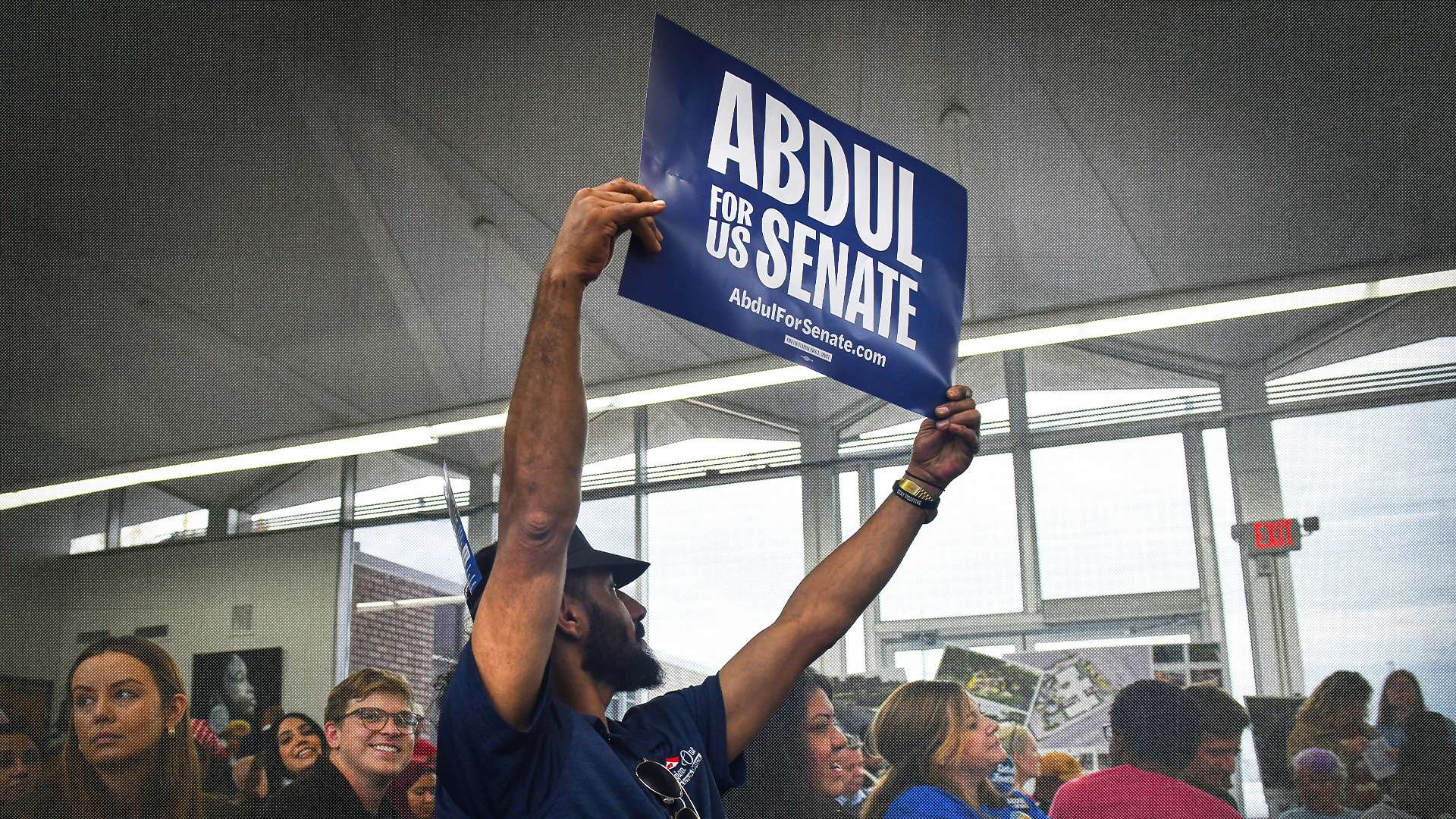
Now the pendulum is swinging back around. The Arab-majority city of Dearborn went from only 36 percent percent for Harris in 2024 to 82 percent for Democratic Senate candidate Abdulrahman Mohamed “Abdul” El-Sayed this year. And that was enough to help push Michigan back into Democratic hands.
Part of the Dearborn swing was a home-field advantage: El-Sayed is the son of Egyptian immigrants who was born in the Detroit suburbs. But it also reflects the fact that Trump, who had closed the 2024 campaign in Michigan alongside Muslim clergy and promised to end U.S. wars in the Middle East, spent the 2026 campaign touting his war with Iran and bashing El-Sayed for his name. And the last-minute defection of Rep. Haley Stevens (D–Mich.) to the Republican candidate’s camp brought Israel back to the forefront of the race.
Arabs (including Christian Arabs) are around 2 percent of Michigan’s population, and Muslims (including non-Arabs) are similarly around 2 percent. But electoral math allows them to punch above their weight. As Cubans in Florida spent decades showing, a bloc that is up for grabs in a state with tight margins can punch above its weight. One reason they have been up for grabs is because politicians from both parties have chosen to target the Middle East and its diasporas.
“I’m a Christian. I’m not even a Muslim, but the fact that Muslims are being targeted in such a demeaning, racist fashion is just crossing a red line,” Bishara Bahbah, the Jerusalem-born founder of the 2024 group Arab Americans for Trump, told The New Yorker last month. “I mean, a lot of the values of the Republican Party match with the values of the Arab and Muslim American voters, which is fine, but sometimes there is a breaking point because when there is no respect for the community, how is the community going to behave?”
Trump told supporters in October that El-Sayed’s real name was “Adulbabababababa Mohamed.” In the same speech, he bragged about the war in Iran and said that “if you’re in doubt about somebody’s name from the Middle East, just say Mohamed.” A couple of weeks before the election, Trump told a Michigan rally that he had come “to keep a jihadist Muslim Brotherhood member from becoming a United States senator.”
Many Muslim Americans understood the name joke to be an insult against Islam in general, according to Ali Harb, a Lebanese-American independent journalist who spent most of his life in Dearborn. He tells Reason about a common sentiment he has heard in the community: “Yeah, I’m a Republican, but how can I vote for someone who insulted my prophet?”
El-Sayed’s Republican opponent, Mike Rogers, accused El-Sayed of supporting the Muslim Brotherhood, an Islamist party in Egypt that briefly took power in 2012 and 2013. During the elections after Egypt’s 2011 revolution, El-Sayed’s sister wrote about how she disagreed with her family’s support for the Muslim Brotherhood. After the Brotherhood won those elections, El-Sayed himself signed a petition by Egyptian Americans encouraging newly-elected President Mohammad Morsi to “purge the media and the police.”
Pressed about the Muslim Brotherhood during a 2026 rally, El-Sayed disavowed the party and said that he has no “higher-order allegiance than to the Constitution” and its religious freedoms. Ironically, Rogers himself struck a supportive tone after the 2012 elections, stating that “there are moderate Muslim Brotherhood individuals we are going to have to reach out to and talk to.”
Although many Arabs in Michigan indeed disagree with the Muslims Brotherhood—especially Christians and Shi’a Muslims—it’s hard to separate these questions about Egyptian politics from the religious and ethnic attacks on El-Sayed. The Senate Leadership Fund, a Republican-aligned committee, ran an ad saying El-Sayed wants to force American women to wear the veil. At one of his own rallies, Sen. Bernie Moreno (R–Ohio) said El-Sayed should be “nowhere near Washington” because he doesn’t understand “that Jesus came here for our salvation.”
It’s also hard to separate these attacks from a hawkish foreign policy towards the Middle East. Rogers is a long-time hawk running on his national security credentials. During his previous congressional tenure from 2001 to 2015, he voted for the Iraq War. Former Rep. Justin Amash (L–Mich.), the first registered Libertarian in Congress and the son of a Palestinian refugee, called Rogers “one of the chief architects of the modern surveillance state and a champion of the forever war.”
This year, Rogers supported Trump’s decision to start a war with Iran. During the televised debate, he argued that El-Sayed “doesn’t believe Iran is any more dangerous than Israel. This is an absolute non-starter if you’re going to send somebody back to the United States Senate.” El-Sayed had claimed that Israel “pushed us to go to war in Iran” in order to achieve “the annexation of southern Lebanon,” where Israel is fighting the Iranian-backed militia Hezbollah; he also blamed the war for Michiganders’ high cost of living.
“Trump came to this city promising to bring peace and end the wars, and instead we got the mother of all wars….He gave Israel a blank check to destroy south Lebanon,” Harb says, pointing out that Dearborn Mayor Abdullah Hammoud’s family hails from Bint Jbeil, Lebanon, “a city that no longer exists.”
A convoluted last-minute drama involving El-Sayed’s former primary opponent, Stevens, drove home that the election was about the Middle East. Rebellion PAC, run by the leftist talk show host Cenk Uygur, ran an ad accusing Rogers of caring more about Israelis than Americans, who it said were forced to pay “for killing Palestinians” and for the war in Iran. The Friday before the election, Stevens published an open letter demanding that El-Sayed denounce the Rebellion PAC ad as antisemitic and take back his own rhetoric blaming high costs on Israeli wars.
El-Sayed responded with a terse statement accusing Stevens of “relitigating a primary that ended three months ago” and pointing out that the American Israel Public Affairs Committee spent money trying to get her elected. On Sunday, Stevens endorsed Rogers at a press conference alongside a registered lobbyist for the Israeli government. Stevens told The Free Press that night that El-Sayed’s soft line on Iran and “obsessive” hostility to Israel helped drive her over the edge. In a 60 Minutes interview aired the same day, Rogers said that his support for Israel “sets me at odds with my opponent right off the bat.”
We’ve seen this pattern play out before. Middle Eastern diasporas were a swing demographic in the 1990s, but the community then largely rallied behind Democrats because of Republicans’ support for wars in the Middle East, domestic anti-immigrant rhetoric, and increasing polarization as the pro-Israel party. That partisan line was dissipating during the Biden administration. Even before the wars in Gaza and Lebanon, Muslims in Michigan were increasingly willing to ally with Republicans on LGBT issues. Yet the trend has reversed once again.
“Had [Republicans] engaged the politically conservative elements of this community, there were votes on the table that they could have gained” this year, says Harb. “I think the Republicans decided that these remaining votes in the community are not worth it. And they concluded that the Arab community serves better as a scarecrow for hateful grievances.”







Leave a comment