
‘Seduced by a dramatic landscape of canyons and lakes’: exploring Catalonia’s wild side | Travel
 adminUpdated 19 minutes Ago5 Mins read
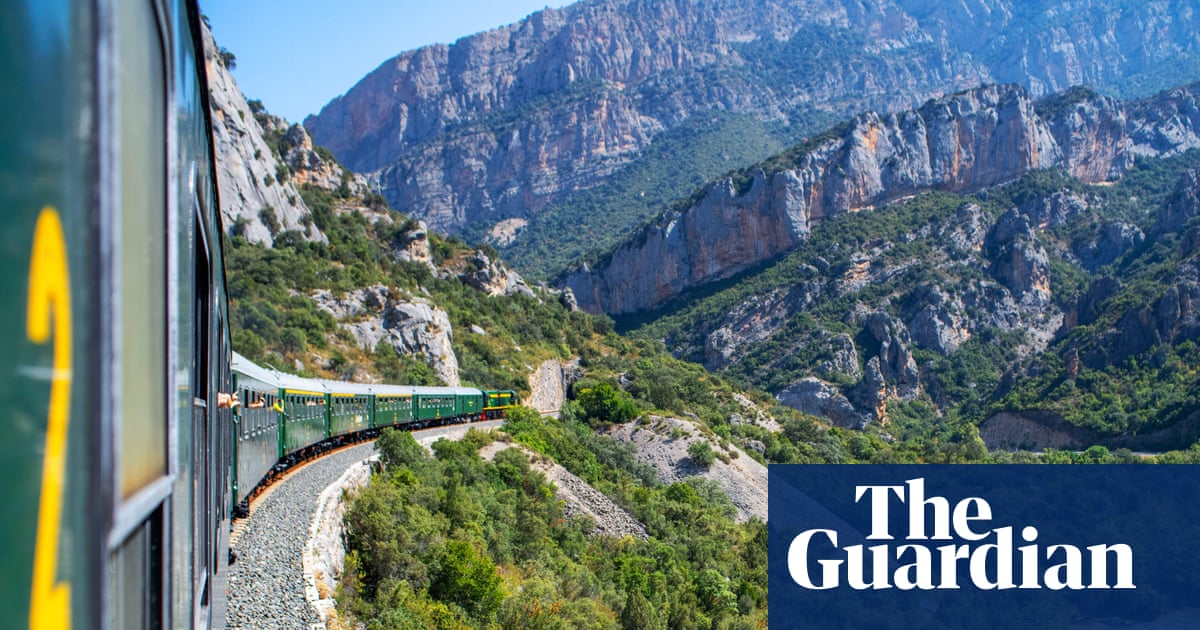
Alighting at the train station of Santa Linya in northern Spain, I paused to wonder what the railway engineers were thinking. A rough halt hewn out of the mountainside, with no ticket office, no waiting room, no sign of human habitation – just a single platform in the wilderness. On the far side of the track, a shimmering turquoise lake flanked by pine forests. Ahead – the only way out – a rocky trail snaking up the limestone cliff.
My husband and I had first strayed into this western corner of Catalonia – Pallars Jussà – on our honeymoon road trip 21 years earlier. Seduced by its dramatic landscape of canyons, lakes, crumbling ruins and the formidable Noguera Pallaresa river thundering south from the Pyrenees, we had vowed to return one day. He loves mountains, I love water, we both love abandoned buildings; it was a geographical match made in heaven. Now those vows had come good – we were back, on a mission to go deeper into the hinterland.
What was apparent on that first trip was that the real gems were found far from tarmacked roads, which is how we ended up standing on the empty platform of what must surely be one of Spain’s most remote train stations, staring up at a very steep climb. We had arrived at Santa Linya on the Tren dels Llacs – the Lakes Train, a service that runs on a single track from the city of Lleida north to the mountain town of La Pobla de Segur. Following the river valley, the line takes in 40 tunnels and 75 bridges along its 55-mile (89km) route, winding through the spectacular landscape of the pre‑Pyrenees. We had chosen to ride the Tren Historic service, a 1960s locomotive in original livery, complete with period dining car and mail carriage. There was the option of a slicker, modern Tren Panoramic, but the varnished wood and vintage furnishings seemed more fitting in this timeless valley.
There was nowhere to go but up. The sun beat down as we began the ascent from the station towards the village of Santa Linya itself. It’s a three-and-a-half-mile rocky hike with a 190-metre (623ft) climb, so it seems unlikely any of the villagers are using this train as a commuter service. But this line isn’t about efficiency, and is all the better for it. Catching our breath in the village, we spotted a small signpost for our ultimate destination – a further four miles east, winding through Spanish oaks, almond and fig trees, the scent of rosemary drifting in the air. Our efforts were finally rewarded as we emerged from the trees at the Mirador del Balconet, a stomach-lurching cliff edge with a sweeping view over the Collegats Gorge and the Noguera Pallaresa River, a dizzying 300 metres below. That a world-class vista such as this is hidden away, miles from the nearest road, seems inconceivable – and reassuring – in our overshared world. Complete silence reigned. Griffon vultures soared and swooped on the thermals, so close we could almost make eye contact, before coming to land on their eyrie on the far side of the gorge.
Hopping on and off at the Tren dels Llacs’ request stops is a fine way to explore this region, but adding a bicycle helps to get deeper into the wilds. This is big country, with a vast network of ancient trails ideal for mountain biking, ranging from steep climbs and white-knuckle descents to gently rolling farm tracks, all linking numerous ruins, from castles to chapels and farmhouses, dotted across the hilltops. Our first trip had been during a roasting summer, but autumn temperatures in the foothills are reliably pleasant into November and ideal for cycling. Arriving in the town of Tremp on the train, we hired a couple of bikes and set off, eventually arriving at the lakeside Hotel Terradets near the village of Cellers (also on the train line), which is so bike-friendly it even has a workshop facility for its two-wheeled guests.
After all our exertion, the hotel appeared like a mirage to us weary travellers. With roots dating back a century, the Terradets was originally an inn providing food and shelter for merchants and muleteers traversing the Montsec mountains. Nowadays, it’s quite the stylish destination for outdoorsy types, offering bike and kayak hire, with a pool and terrace overlooking the Embalse de Terradets. This reservoir was created when the Noguera Pallaresa was dammed in 1935, and almost 100 years later it’s hard to believe the lake is not part of the natural landscape. Its shores are wild and unspoiled, with sandy beaches and pine groves, but beneath its calm, glassy waters lurk the ruins of the monastery of Sant Miquel de Cellers, submerged during the flooding of the valley.
It was a challenge to drag ourselves away from the Terradets, not least because of its restaurant. Carnivores will be happy in Pallars Jussà, with the ubiquitous escudella pallaresa, a local meat stew, as well as Pyrenean river trout and cod cooked in local Montsec honey. Crema catalana, the regional version of crème brûlée, is the default (and delicious) dessert to be found everywhere. But a word of warning: if, like me, you find yourself seduced by the romantic-sounding postre de músic (musician’s dessert) – it’s a saucer of nuts and raisins. (This musician wished she’d ordered the crema catalana.)
after newsletter promotion
The menus are not the only reminder that you are very much in Catalonia. You won’t find any tapas round here; you certainly won’t find a menu in Spanish, and attempts to speak español are tolerated only from foreign visitors. In the towns, the population is small but the resistance is strong; the Estelada, the separatist flag, hangs from balconies and windows, while its red and yellow stripes are painted on roads, bridges and walls, along with pro‑independence graffiti ranging from the galvanising Fem República! (Let’s build the Republic!) to the more direct Puta España (Google it).
After some rest and recuperation at the Terradets and daily swims in (and occasionally across) its magnificent lake, we were ready to take to the road again, for Pallars Jussà’s pièce de résistance. The Balconet had been a mere warm-up for the big one: the king of Catalan gorges lies in the next valley west, where the Noguera Ribagorçana River carves its path through 500m vertical cliffs, narrowing to a channel just 20 metres wide. This mighty river is the border between Catalonia and the Aragon region, creating a truly impassable frontier by way of the Mont-Rebei Canyon. We drove as close as we could get, but Mont-Rebei is famous for being the only gorge in the region surrounded entirely by pristine wilderness. Access is via a dirt track, and the gorge itself is not crossed by any roads, railways or power lines. We decided the best way to view its sheer magnitude was from the water, and hired kayaks to paddle the round trip of three or four hours from nearby Corçà, awed as we slithered between its towering rock walls. High above us, halfway up the cliffs, walkers appeared like tiny ants, negotiating a metre-wide path cut into the rock face.
This vertigo-inducing path was created a century ago, using dynamite, hand chisels and picks, as a route to connect remote communities. These days, getting around this wild corner of Catalonia is a little easier but it still takes time. There are no motorways in Pallars Jussà and life moves slowly (the four-hour siesta has caught out many an unsuspecting visitor), but there’s a connectedness to the land and its natural rhythms, and a spirit of resourcefulness that permeates everyday life. For the gentle traveller, or indeed, nostalgic honeymooners, the rewards are rich.





Leave a comment