
‘The End of Oak Street’ is a nasty, effective exercise in dinosaur terror
 adminUpdated 2 hours Ago3 Mins read
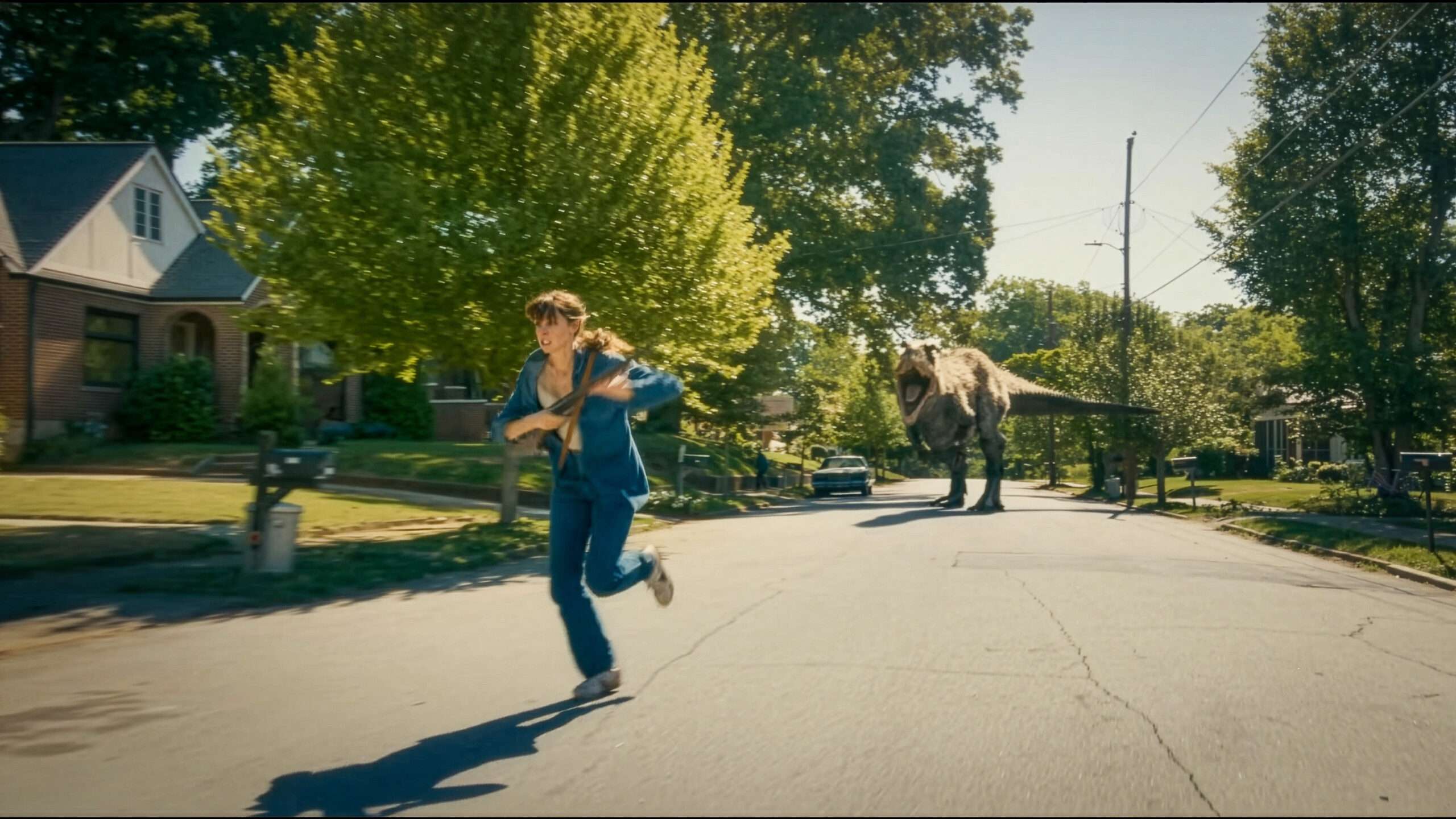
There’s something primordially satisfying about watching a big-screen dinosaur get the what-for from the business end of a just-loaded shotgun. The recent run of Jurassic Park movies sometimes seems to have lost this primal pleasure, replacing it with ho-hum computer-generated spectacle and cheap nostalgic callbacks to the franchise’s better days. They’ve forgotten that the franchise was founded on a combination of awe and white-knuckle terror—the raw and relatable fear of a giant, toothy monster that stalks the earth with a sort of evolutionary arrogance that comes from a couple million years atop the food chain.
Newsflash: Humans rule the planet now. It’s fun to watch these ancient planetary powerhouses get taken down a peg. Sic semper Tyrannosaurus.
The End of Oak Street remembers what the Jurassic Park franchise has largely forgotten. It leans into the animal terror of encountering a dinosaur on the streets of an ordinary suburb. Set in the early 1980s, the movie lifts brashly from early Steven Spielberg, especially E.T., depicting a seemingly ordinary family with its own ordinary troubles who find themselves in a sort of dinosaur-ridden episode of The Twilight Zone. The End of Oak Street director David Robert Mitchell can’t quite match Spielberg’s everyman pathos nor his talents as a sequence maestro—though who can?—but in its best moments the movie is terse, terrifying, and thrillingly mean, with a bloody-mindedness that’s rare for PG-13-rated summer fare.
Part of the movie’s success stems from the fact that it doesn’t bite off more than it can chew. This 99-minute movie takes place entirely in a small suburban enclave, and, for the most part, follows the travails of a single family, with a few nods to their neighbors. The film’s all-American family consists of a mother (Anne Hathaway), a father (Ewan McGregor), and a son and daughter who might as well be named “the son” and “the daughter.” For the first half an hour or so, we see them struggle to maintain an outward appearance of normalcy even as it’s clear the marriage, and the family, is falling apart.
And then the dinosaurs arrive. (You could make a lot of movies with that as the premise.)
Will the emergence of feathered allosaurs bring them back together? The reason for the dinosaurs doesn’t matter; these are premise-monsters. There is some hand-waving about Carl Sagan and wormholes, but they are there because they are necessary. What matters is that the entirety of the family’s block and surrounding neighborhood is transported back in time so that thunder lizards now stalk the streets.
One question this movie asks rather pointedly is: Are they really lizards? This movie assumes what Jurassic Park only hinted at: that these menaces weren’t scaled, cold-blooded meanies but rather feathered—even furry—birds of prey.
But scales or feathers don’t really matter when they’re about to eat you and your neighbors. Which happens, and more than one might expect.
Although Mitchell keeps things just barely on the PG-13 side of the ledger, the movie’s body count is higher than one typically sees in this sort of family-focused summer romp, as the assorted dinos turn suburbia into a very bloody mess. Mitchell’s point seems to be: They’re dinosaurs. These are ordinary people. Of course the dinosaurs would win. At least, that is, until Hathaway starts pumping the shotgun and McGregor picks up a sledgehammer to save their kids.
Mitchell nods to Jurassic Park throughout, most notably with a mid-movie sequence set in a car that recalls the T. rex encounter that anchors the earlier film. But Mitchell is more interested in the bloody havoc these dinos would wreak on an ordinary block, the way they would disrupt and upend middle-American normalcy. His point, made with surprising bite, is that faced with dinosaurs, ordinary people would stand no chance at all. It’s ridiculous to think they would. Only through a combination of great courage and even greater luck would they survive, which, come to think of it, might be a metaphor for ordinary American families too.
The movie’s closing twists are perhaps too cute, too convenient, and too weird—don’t think about them too hard—but they do provide the necessary closure. Everyone, even the dinosaurs, gets what they deserve, more or less. And surprisingly, given the various dino-disappointments that have plagued multiplexes in recent years, that includes moviegoers too.







Leave a comment