

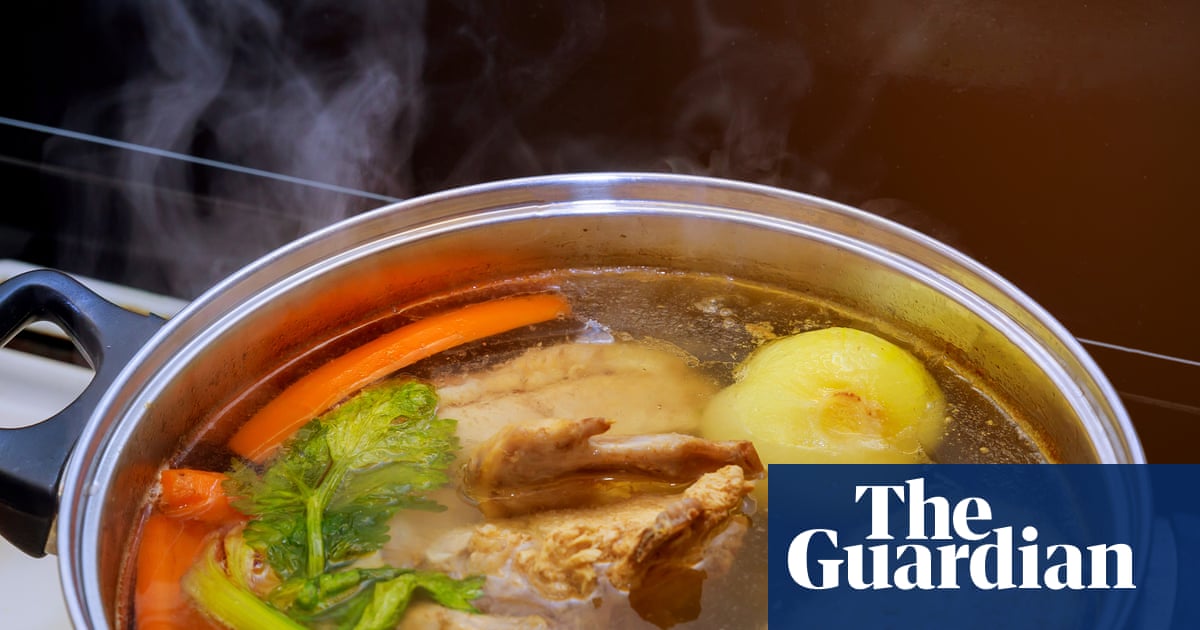
Why is my chicken stock always cloudy?
Ryan, by email
From broths and risottos to sauces and braises, there’s no question that a good, flavourful stock will stand you in good stead. “It’s an underestimated kitchen job,” says Adam Byatt, chef/owner of Trinity, in southwest London, and author of Trinity: The Cookbook, which is published next week. “I love stock: it’s wholesome and fruitful, frugal and delicious.”
Ryan’s clarity issue, Byatt says, is “only ever caused by cooking the stock too quickly or by allowing the fat to boil back into the base liquid”. So it’s crucial to take things low and slow. You will also need a pan that’s “big and heavy enough to give the bones enough room for movement, as well as a very fine sieve for straining the stock”.
On to the actual making, and Alissa Timoshkina, author of Lozhka, goes in cold. She puts chicken legs, drumsticks or a leftover roast chicken carcass in a large pot, adds her stock veg – onions, carrots, celery, garlic, say – and aromats (bay, parsley stalks, peppercorns, for instance), then covers the lot with cold water and brings everything very slowly to a boil. She then turns down the heat and leaves it to cook on a very gentle simmer. In the event of that carefully made stock going a bit cloudy, Timoshkina would seek to mollify that by straining the lot through a fine sieve and stirring in a tablespoon of lemon juice, which has the added benefit of being “great for flavour, too”.
Lloyd Morse, chef and co-owner of The Palmerston in Edinburgh, meanwhile, likes to simmer the bones first, “shoogling them occasionally”, to bring more of the scum to the surface: “You really need to skim the life out of it.” It’s only at this point that he adds the veg: “And keep skimming that top layer,” he says, adding that it’s important to be aware that “the more agitation or the hotter the pot gets, the cloudier the stock will be”.
Essentially, “if nothing is ever actually boiled, Ryan’s stock should be nice and clear”, says Louis Lingwood, head chef at Osteria Vibrato in London, who cooks his chicken stock “on the lowest possible heat for a whole day”, before discarding the bones and leaving the stock to sit until all the fat rises to the top. Skim that off with a ladle, then reduce the stock very slowly.
Lingwood has another trick up his sleeve to guarantee a clearer stock: get it in the freezer. “Defrost it through a sieve lined with muslin (or through a lined perforated tray), and the stock will be crystal clear.” Speaking of the freezer, freezing stock in ice-cube trays, then whacking them in a sealed container, is a welcome manoeuvre for those occasions when only small quantities of stock are required.
Of course, Ryan could make his life a whole lot easier by simply cooking his stock in the oven, Morse says: “My top tip is to make it in an oven-safe dish, such as a Le Creuset [other brands are, of course, available], then pop it in the oven overnight to cook super slowly,” by which he means about 90C. “The indirect heat makes the clearest stock possible, plus, when you wake up, you’ll have a lovely smell in the kitchen.” Convenience food at its best.










Leave a comment