

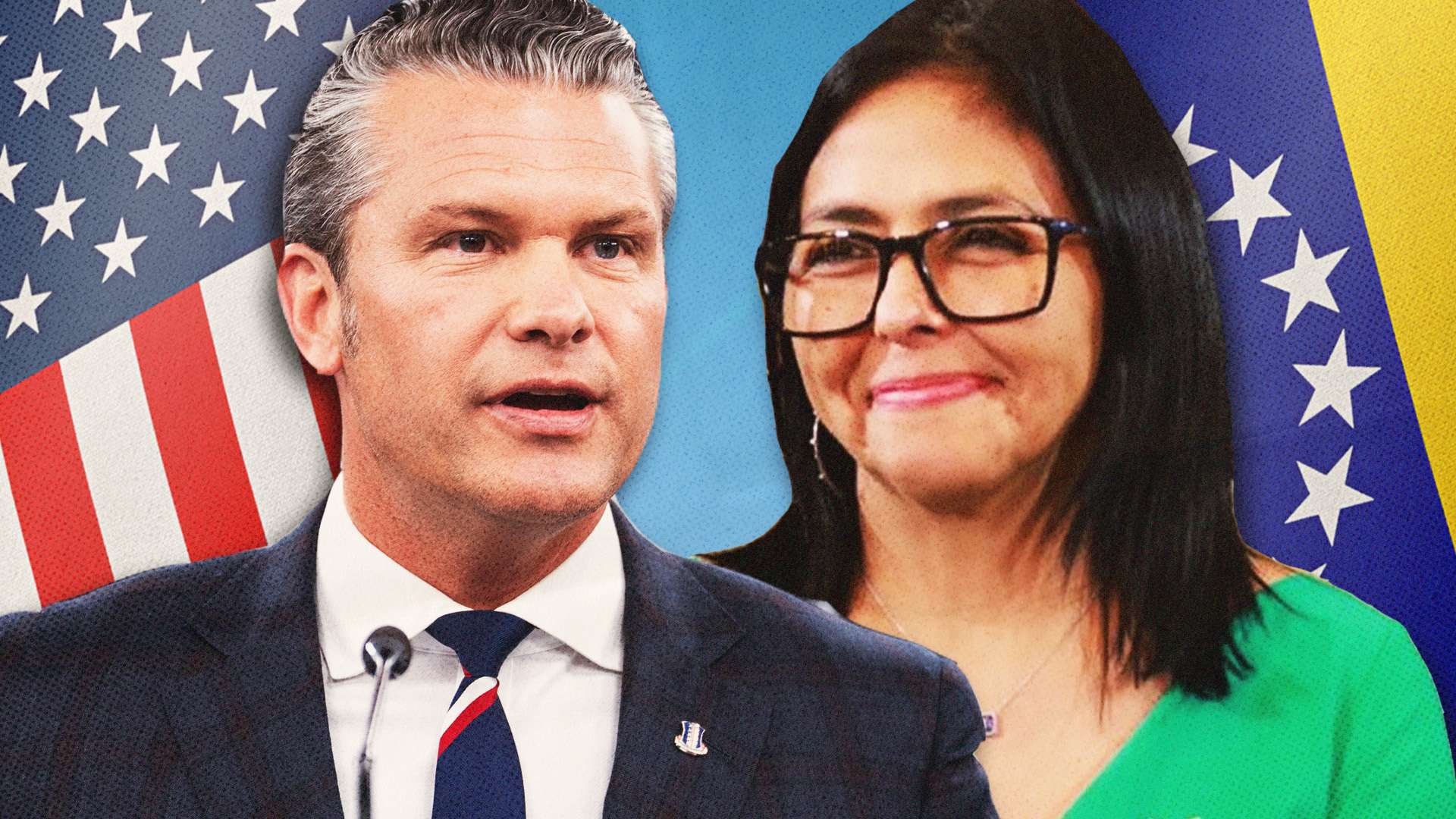
“I want to personally thank President [Delcy] Rodríguez for working closely and pragmatically and diligently with the United States to stabilize Venezuela,” said Defense Secretary Pete Hegseth while standing outside the Miraflores Palace in Caracas on Wednesday.
Hegseth and Venezuelan Defense Minister Gustavo González López—who is currently under sanctions from the European Union, the United Kingdom, Canada, and the U.S. for alleged human rights abuses—signed a military cooperation document to “advance U.S. and Venezuela military cooperation and combined operations.” In Caracas, Hegseth said that would include joint training, partnerships, intelligence sharing, and the provision of “defense equipment and capabilities.” However, the specifics of the agreement have not been made public.
In his speech, Hegseth recounted the capture of former Venezuelan dictator Nicolás Maduro by U.S. forces in January, crediting it with “ending the decades-long war waged by narco-terrorists in Venezuela against the American and Venezuelan people.”
Hegseth said that the “renewed defense partnership will not simply be cosmetic,” but instead require the “removal and eradication of all narco-terrorist networks usurping territory inside Venezuela today.” While the specifics of the partnership are unclear, Hegseth’s statement almost certainly implies additional extrajudicial missile strikes against fishing boats—which the White House has justified as necessary to halt narco-trafficking in the Caribbean and eastern Pacific Ocean—are on the horizon.
“Since September 2025, U.S. forces have carried out 72 strikes against alleged drug-trafficking boats, killing at least 244 people,” according to The New York Times. This includes 11 men killed off the northeastern coast of Venezuela in the inaugural boat strike in September 2025. In a Truth Social post, President Donald Trump claimed that the 11 were “positively identified Tren de Aragua Narcoterrorists” who were “transporting illegal narcotics, heading to the United States.” In September, a year after the first boat strike, lawmakers from 13 countries in the Americas released a letter opposing the Pentagon’s “attacks on small vessels in the Caribbean and eastern Pacific that have resulted in hundreds of extrajudicial killings of civilians.” The lawmakers called for an end to these “egregious violations of international law.”
The Trump administration’s strategy of joint military strikes has faced pushback from some Latin American nations, including Mexico, Guatemala, and Colombia. On Wednesday, the Times reported that Colombia’s President Abelardo De La Espriella had rejected a plan to “allow the United States to conduct joint military operations in his country.”
Questions also remain about the Trump administration’s legal justifications for the boat strikes, although a recent court ruling could bring more clarity. In September, U.S. District Judge Paul Engelmayer of the Southern District of New York rejected the Trump administration’s argument that it could not release a memo outlining its legal justification for the strikes for national security reasons. While Engelmayer has yet to rule on releasing the government’s memo, he wrote that it was “all but certain” that parts of the memo, including its “presumably thoroughgoing analysis of the law governing the boat-strike program,” would likely be subject to the Freedom of Information Act and available for public release.
Whatever legal justification the Justice Department concocted, a government memo is unlikely to sway lawmakers in Congress who have already signaled their preference for Hegseth to step aside as defense secretary. The boat strikes were listed among the charges Rep. Thomas Massie (R–Ky.) brought when he tried to impeach Hegseth earlier this month. Massie accused Hegseth of violating his constitutional duty and abusing the powers of his office when he directed the “extrajudicial killings.” Republicans effectively stalled the measure by voting 211–204 to refer the impeachment articles to a committee for further study. Still, Rep. Hakeem Jeffries (D–N.Y.)—the incoming speaker of the House—told ABC News’ This Week that he was a “hard yes” on impeaching Hegseth. With the incoming Democratic majority already acting on its promise to hold the administration accountable, it could be a troubling new year for the defense secretary.
Congressional scrutiny aside, the Trump administration could soon be forced to defend its rationale for the lethal boat strikes in federal court. On Monday, the Times reported that 17 Ecuadorian fishermen filed a lawsuit in Pittsburgh against the United States, “claiming American military drones bombed their vessel in the Pacific Ocean earlier this year.” While the Pentagon and Coast Guard have denied any involvement, the fishermen claim to have evidence that U.S. forces carried out the strike. They are seeking an order “halting U.S. strikes on small boats in the Caribbean and eastern Pacific.” It’s the second such lawsuit brought against the Trump administration for its extrajudicial maritime killings. In January, the relatives of two Trinidadians killed in a strike filed a similar lawsuit in which they described the government’s actions as “murder.”
The visit to Caracas makes clear that the Trump administration sees an expanded role for the U.S. military in the country, regardless of who leads Venezuela in the coming years. For years, the U.S. government has maintained that the Maduro regime, including current dictator Rodríguez, was an illegitimate government holding the Venezuelan people hostage.
Now, in a sick twist of irony, the Trump administration is entering into a partnership to strengthen military ties between America and a regime that stands accused of carrying out extrajudicial killings of its own citizens.







Leave a comment