
What does it say about the UK’s pro-Europeans that they hide their message behind a bin? | Simon Nixon
 adminUpdated 2 hours Ago3 Mins read
The UK could be forgiven if, like Brenda from Bristol, it feels it has had too much politics of late. The long death rattle of the Starmer government against a backdrop of relentless excitement from the White House has left everyone suffering a severe case of overwhelm. We all deserve a holiday – even Andy Burnham, exhausted after a few weeks in the job.
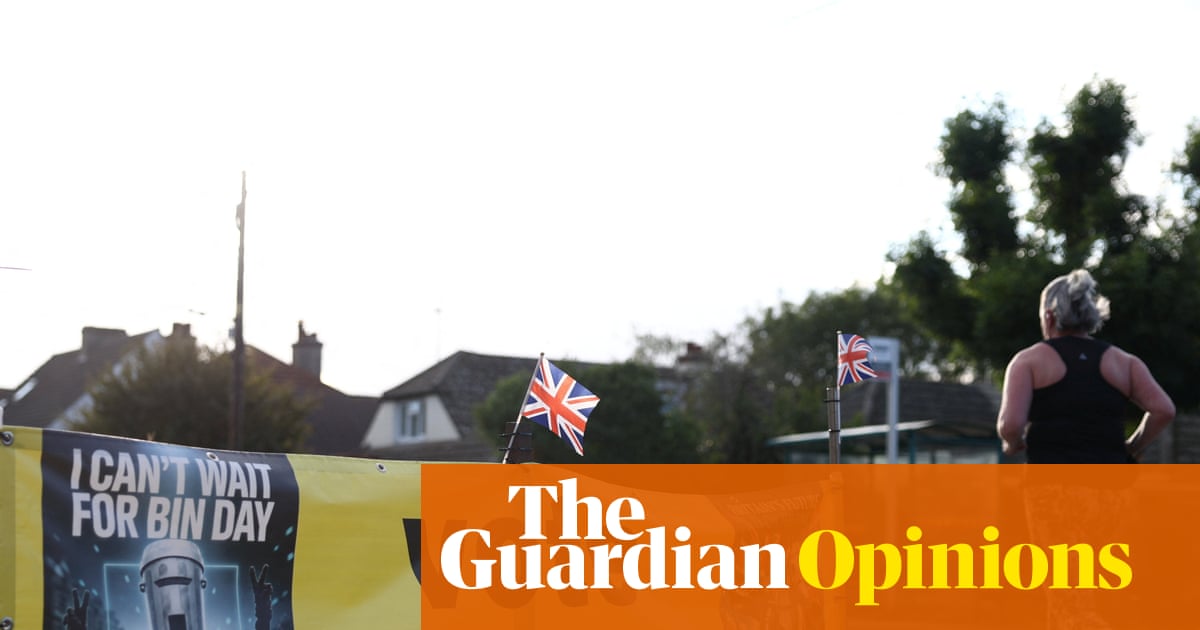
So the political and media class may think they are doing us a favour by turning the forthcoming byelection prompted by the resignation of the Reform UK leader, Nigel Farage, into a joke. But it is not very fair on the people of Clacton, who are being told they face a binary choice on 13 August, between Farage and the novelty candidate Count Binface.
Most people outside the Essex constituency have already picked a side. Unless you are a diehard Reform supporter, everyone seems to be backing the bin. A huge media operation is in full swing, in the hope that Clacton voters will oblige by embarrassing Farage. A speaker on BBC Radio 4’s Thought for the Day piously informed listeners that Binface’s candidacy belongs to a rich tradition in Britain of political satire that has its origins in the parables of Jesus Christ. The new high priests of political broadcasting, Alastair Campbell and Rory Stewart, bestowed their blessing on Binface with the sacrament of a podcast interview.
Yet the Clacton byelection is not a two-way contest. There are, in fact, 34 candidates on the ballot – but there is one other candidate who, unlike Binface, is running a highly professional, constituency-wide campaign: John Stevens, of the Rejoin EU party.
Stevens, a former Conservative member of the European parliament and ardent pro-European, insists that there are many voters in Clacton who dislike Farage and are no fans of Brexit, and he is determined to give them a voice – so I went to see for myself.
Based on my observations of Stevens and his enthusiastic team of volunteers, marshalled by a formidably well-organised agent, as they delivered leaflets across three different parts of the constituency, he is right. The places we visited may have been chosen because data gathered via Facebook suggested they were fertile territory. But in the quieter streets of genteel Frinton-on-Sea and the tidy new-build estates of the surrounding villages, there was striking hostility to Nigel Farage, and an overwhelming view that Brexit had failed.
True, not all thought it had failed because it was a bad idea; nor did they necessarily blame Farage as opposed to the Tories for what most thought had been a terrible mistake; nor were they all convinced that the cost of rejoining would be worth it. But what was also clear was that many people were uncomfortable about expressing their opposition to Farage by voting for Binface. Unlike Radio 4’s sermoniser, they did not feel they had divine permission to turn a sacred democratic right into a national punchline. Nor did they think it would reflect well on Clacton, or the country.
An Ipsos poll suggests they are not alone. It found that just 25% of voters nationally have a positive view of joke candidates, falling to just 13% of Conservative voters – and Clacton pre-Farage was one of the safest Tory seats in Britain. All of which suggests that pro-Europeans relying on Binface to give Farage a bloody nose may be in for a disappointment.
Besides, it is one thing to tell a pollster that you are inclined to cast a protest vote. It is quite another to head to the polling station to cast it in person – particularly when Binface, unlike Stevens, has little by way of a ground campaign to get you out to vote.
And yet, ironically, the strongest opposition to Stevens comes from fellow pro-Europeans, who accuse him of splitting the anti-Farage vote. They assume that a vote for Rejoin EU is one vote lost for Binface, rather than a positive choice by someone who otherwise would not vote at all. Prominent pro-Europeans have not only ignored his candidacy but privately admonished him for campaigning for the cause he has championed all his career – in an election that, thanks to the boycott of mainstream parties, is a golden opportunity for voters to make a statement.
after newsletter promotion
This seems remarkably shortsighted. What does it say about the strength of the pro-European cause in Britain that it dare not make its case in public? Many pro-Europeans complain about the timidity of politicians. Andy Burnham’s EU policy is a blank sheet, perhaps to be filled in on the beach. The Liberal Democrat position is an unworkable fudge. But how are those who earnestly wish to reverse Brexit ever going to shift the Overton window if they are so afraid of making an argument that they hide behind a bin?
It is clear from the number of Reform placards plastered around Clacton that Farage will win his byelection handily. A show of support for Rejoin EU in Farage’s heartland would at least send a signal that Westminster could not ignore. But a vote for Binface fuelled by nothing more than media vibes would be devoid of any useful information about Farage, Clacton or Britain. The joke would last about 24 hours. And it would be on all of us.









Leave a comment