

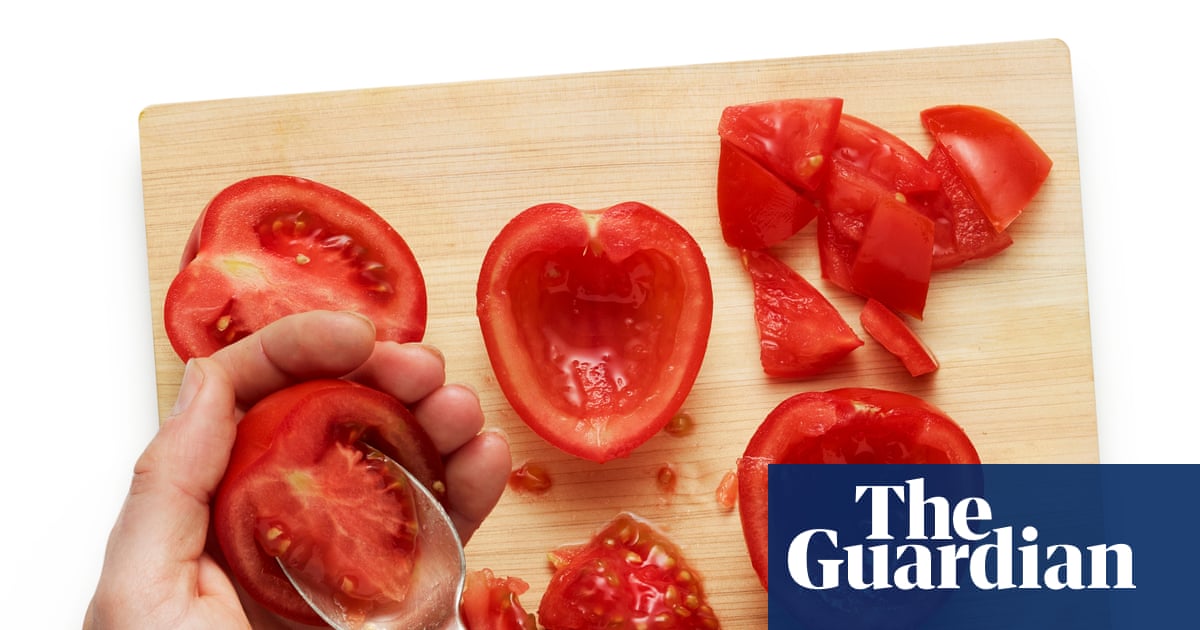
Why do recipes often say to deseed tomatoes? Isn’t that where the flavour is, especially since the seeds don’t make much difference to a sauce’s texture?
Catriona, by email
“It all depends on the variety of tomato,” says the Guardian’s Rachel Roddy, “because some are much seedier than others. Sicilian varieties that require little watering, for example, have loads of little bitter seeds, which do need flicking or sieving out.” If, however, Catriona had some vesuvio tomatoes destined for a salad, Jay Patel, co-owner of Italian restaurant Legare in London, wouldn’t bother: “Those are generally pretty meaty and don’t have many seeds, so I’d just slice and dress them generously with olive oil and salt, and you’ll have something pretty special.” And that’s the crux of the matter: as well as the type of tomato, the answer hinges on what you’re planning to do with them, too. “If you’re making a salad with watery winter tomatoes, say, there’s a purpose for those seeds,” Patel adds, “because they provide a lovely pop as well as acidity.”
The most common deseeding scenario is for pasta sauces, but even that comes with a caveat, Patel says: “If I’m going for a slow-cooked sauce, it’s tinned chopped tomatoes, seeds and all. But if I’m after a lighter, fresher tomato sauce, I’ll quickly blanch, peel and deseed fresh tomatoes myself.” Nick Molyviatis of Zylia in London, meanwhile, scoops out the seeds with a teaspoon or he grates his tomatoes instead – “the skin acts as a protector, a glove” – while Roddy’s “best defence against seeds” is a food mill: “Seeds don’t contain flavour as such, but the fleshy gel around them does, which is why a food mill is great,” she explains. “It presses the flavour from that and the skin, while at the same time separating them from the sauce base.”
Mind you, that gel in which the seeds are suspended is watery, too, which is why Patel shuns it in the likes of tomato tarts: “You want to remove as much water as possible, because it will make the pastry soggy,” he says, so it’s best to deseed the tomatoes before slicing them uniformly. “Once baked, you get these lovely, almost semi-dried tomatoes.” And not a soggy bottom in sight.
But it’s not just about the seeds. “The texture of the skin also messes things up sometimes, and it’s not that pleasant to pick out of your teeth, either,” Molyviatis says. But again, Roddy notes, to peel or not to peel generally depends on the dish and, “more importantly”, on the variety of tomato: “Thin-skinned toms aren’t a worry,” she says, “but thicker skins are not only pesky to eat, they can also twist into scrolls during cooking, and are very annoying in some sauces.”
To peel her toms, Roddy plunges them first into boiling water and then into cold to loosen the skins; failing that, she passes them through – yes, you’ve guessed it – her trusty food mill. Patel, on the other hand, tends to rely more on a knife, especially if bull’s heart tomatoes are involved: “They’re so easy to peel with a serrated knife.” Sure, it’s a bit of a faff, but it’s worth the effort, he insists. “When you’ve paid good money for good ingredients, it’s always worth going the extra mile.”











Leave a comment