

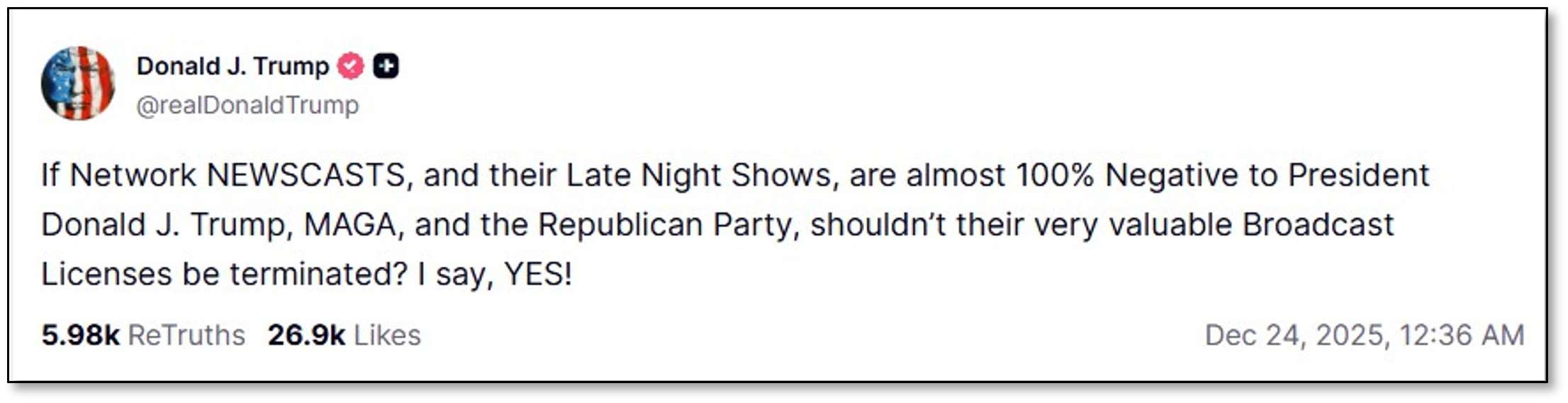
Government censorship is deeply un-American. That fundamental principle predates the Republic, with our Founders recognizing that “the freedom of the press is one of the great[est] bulwarks of liberty.” And it is no less true today, as the Supreme Court unanimously reaffirmed only two years ago: the government may not “use the power of the State to punish or suppress disfavored expression.” NRA v. Vullo (2024).
This case concerns the Administration’s sustained effort to do just that. Acting through the Federal Communications Commission, the Administration has waged a retaliatory campaign against ABC for a single reason: it disapproves of what ABC broadcasts.
That campaign began in this Administration’s earliest days and has only intensified since. Again and again, the Administration has attacked ABC’s speech—the stories its journalists report and the viewpoints its network programs air. Over time, those attacks have escalated into express demands that ABC be stripped of its broadcast licenses because of its speech.
In prosecuting the Administration’s campaign against free speech on network television, the Commission fights on several fronts using its expansive regulatory powers. What has unfolded, in the words of sitting FCC Commissioner Anna Gomez, is “a sustained, coordinated campaign of censorship and control, carried out through the weaponization of the FCC’s authority as a federal regulator and aimed at pressuring a free and independent press and all media into submission.”
The Administration has not been shy about openly coercing ABC into changing its programming. For example, in response to on-air comments by ABC’s late-night host Jimmy Kimmel, the FCC’s Chairman issued an ultimatum to Plaintiffs: “We can do this the easy way or the hard way. These companies can find ways … to take action … on Kimmel, or there is going to be additional work for the FCC ahead.”
For months, the Administration has steadily increased the pressure on ABC, culminating in the present threat to the broadcasting licenses of the eight ABC Owned Stations (“the Stations”). The day after the President objected to additional on-air comments by Mr. Kimmel, the Commission issued an unprecedented order requiring the Stations to file early applications to renew their licenses—years before any of their licenses would have come up for renewal in the ordinary course and allowing only thirty days to file applications which ordinarily take months to prepare. Until the day before that order issued, the Commission had not called for a renewal application ahead of schedule in more than half a century. Nor had it ever demanded simultaneous early renewal applications from a group of stations commonly owned with a single broadcast network—much less stations with the record of public service and award-winning journalism like these Stations. In a contemporaneous interview, the Chairman did not mince words when explaining the Commission’s decision to ramp up its pressure on ABC: “If you didn’t take us seriously, now you should.”
The Commission has demanded a review of the Stations’ licenses extraordinarily early. For all but two of the Stations, this early review comes before their current license terms have even reached the halfway point, and years before the Commission is statutorily authorized to grant renewal. That timing underscores the Commission’s true purpose: coercing and retaliating against a network that refuses to bow to the Administration’s demands…. With the threat of non-renewal or revocation of its Stations’ broadcast licenses on the line, ABC cannot ignore the consequences of any decision that might anger the Administration or the FCC Chairman. On July 16, 2026, the President made a primetime address. ABC made the editorial judgment not to broadcast the address live. ABC was aware that the President wanted the address to be broadcast live, and considered the risk of resulting Administration retaliation. ABC ultimately decided to livestream the speech on ABC News LIVE, which it ordinarily would not have done.
In direct response to ABC’s decision not to broadcast his address—and during the address itself—the President called for the revocation of the ABC Owned Stations’ broadcast licenses, as well as those of NBC, which had similarly chosen not to broadcast the address: “NBC and ABC fake news have both said that they would not cover this speech …. [T]his should mean a revocation of their licenses.”6
The Administration’s threats to ABC’s licenses were not new. But this threat landed with unusual force, because the Commission had just called those very licenses up for early review. And the Commission promptly confirmed the connection: following the President’s demand, the Chairman stated that the Commission would consider ABC’s decision not to broadcast the July 16 address as part of its review of the Stations’ renewal applications.
The Commission is poised to make good on its threat any day now: the public comment period on the renewal applications has closed, and the Commission may, at any moment, issue an unprecedented Hearing Designation Order for all eight Stations, which would kick off a formal agency adjudication to determine the fate of ABC’s licenses. On July 15, 2026, Bloomberg reported that the FCC was “expected to take action against [ABC] … as soon as next month.” According to individuals “who asked not to be identified because the discussions are private,” the FCC was planning to take action “likely timed before the Labor Day holiday.”
Any FCC adjudication would be a charade. The Commission cannot lawfully grant renewal this early in the license terms—the only outcomes on the table are adverse to Plaintiffs. At one extreme, the Commission may intentionally prolong the adjudicative process, miring ABC in years of costly litigation, with the threat of adverse action ever present and with every editorial judgment shadowed by the prospect of provoking the Administration into further retaliation. After all, “the value of a sword of Damocles is that it hangs—not that it drops.”
At another extreme, the Commission may use the hearing to deny license renewal or immediately revoke the Stations’ licenses, forcing Plaintiffs off the air entirely, as the President has repeatedly demanded. In either scenario, the Administration accomplishes its goal of eliminating a perceived media critic: either it gets Plaintiffs to fall in line, or it silences them if they refuse.
The Commission’s retaliatory campaign against ABC has drawn condemnation from across the political spectrum. Senator Ted Cruz has warned that the Commission’s attempted censorship of ABC is “dangerous as hell.” Likewise, Senator John Kennedy recently commented that “the FCC scares me right now” as it is “getting into the foothills of violating the First Amendment.” He explained further that he “do[esn’t] like some of the stuff that is said on television, but what business is it of the FCC?” Less than two months ago, Supreme Court Justice Neil Gorsuch cited the Commission’s threats in response to Mr. Kimmel’s late-night comments as a cautionary tale of what might be done by a too-powerful executive agency to “[a] business out of favor with the party in control of the White House.” Trump v. Slaughter (Gorsuch, J., concurring). And in a public comment in the Stations’ renewal proceeding, a bipartisan group of former FCC Commissioners and senior officials condemned the Commission’s early review of ABC’s broadcast licenses as “an assault on free speech disguised as regulatory process.”
The consequences of the Administration’s campaign against free speech reach well beyond ABC. If the Administration gets its way, the message to every media company in the country will be unmistakable: tell only the stories the Administration deems favorable, or face the coercive machinery of the federal government. In such a world, the press could in no way be described as free.
The FCC Chairman has left little doubt that this is his goal. He has publicly touted the Administration’s success in extracting speech-related concessions from other media companies, boasting that it has “t[aken] on the fake news media” and is “winning,” cataloguing with evident pride the perceived critical voices that have been taken off the air.
Facing this existential threat, Plaintiffs have no choice but to seek redress from the judicial branch for the Administration’s blatant retaliation for their First Amendment speech. Plaintiffs come to this Court reluctantly with no alternative means to eliminate these ongoing and immediate threats other than total capitulation to the Administration’s demands. This Court should immediately enjoin Defendants from taking or threatening to take any action against Plaintiffs in relation to the early license renewal applications, including issuing a Hearing Designation Order in connection with Plaintiffs’ renewal applications.
I’m not an administrative law expert, so I can’t speak to whether there are procedural barriers to this sort of request for an injunction against the FCC. But the substantive First Amendment objections that ABC raises strike me as very serious.









Leave a comment