
Island hopping through stone-age history in Ireland, Wales and the Isle of Man | Heritage
 adminUpdated 2 hours Ago6 Mins read
The guide was adamant. “I’ve picked human teeth out of there and I’m not doing it again.” The small group of tourists looked suitably aghast, except the boy. He was jiggling the wellington boots on his feet and singing to himself. He looked about 14. I sensed that he was the catalyst, the one to make things happen.
“So, if anyone is planning to leave human remains in this ancient place,” went on the guide, throwing the boy a stern look, “I say, DON’T.”
We had arrived on the visitor centre bus from nearby Knowth, the first stop on our tour of Newgrange Neolithic site, 30 miles (50km) north of Dublin. I was on a circuit of the Irish Sea, a ferry and road trip to see the best ancient sites that ring this salty mere at the heart of these islands. It was here, around 5,100 years ago, that a new people arrived and, capitalising on the sea as a cultural superhighway, constructed a dazzling array of stone monuments. Some of Europe’s finest Neolithic passage tombs are here, notably at Newgrange, the only one you can enter. But as the guide was sternly pointing out, some modern folk are irresistibly drawn to leave the ashes of deceased relatives inside, especially at Newgrange.
The plush visitor centre had been informative but had not conveyed the deep atavistic intensity that drives such tributes. There was magic here. I wanted to feel it. I had a hunch this boy was in touch with it.
“As for pets,” said our guide, “I want no dog or cat ashes either.”
The boy was drumming his hands on his knees, hearing an unheard rhythm. We were about to walk up to the hallowed tumulus with its 19-metre-long passageway that leads to the central chamber, but our guide was determined to get that boy’s attention. “There,” she shouted. The boy’s head shot up. She was pointing at a set of wheelie bins in the corner. “I can promise you,” she went on, grimly, “that if I find your granny’s remains inside my Neolithic chamber, then her last resting place will be that green wheelie bin.”
There was a stunned silence among the tourists. But not the boy. He immediately ran over to the bin, opened the lid and stared inside.
“Nothing,” he reported, slamming it down. “She’s not there.”
The guide looked nonplussed, then marched away towards the hill that is a tomb. “Follow me,” she commanded. “Do not leave the path.”
Everyone obeyed, except the boy. He ran in a great arc off the path, arms flapping like shamanic wings.
We had started our huge circular journey around the Irish Sea at Pentre Ifan, a magnificent tomb from 3500BC, sited on the same Pembrokeshire ridge that provided the bluestone for Stonehenge. I was travelling with my partner, Sophie, and our dog, Stevie, who had gone through complex hoops to prove he was not carrying either rabies or tapeworm into Ireland. He liked the first ferry, from Pembroke Dock to Rosslare; it had an excellent pet lounge, but what fascinated him was the sea. He could not stop staring. His reaction made me pay more attention to him. Could dogs, I wondered, also help connect us with the deep past? After all, their wolf heritage is 30,000 years old, yet they relive it every minute of their lives. If anyone could remember the Neolithic age, it was Stevie.
He had been well cared for initially. We stayed near Wexford, in a dog-friendly hotel, Marlfield House, with superb gardens. Then we toured the ruins of the greatest Irish saint of them all, Kevin. His sixth-century seat at Glendalough, in County Wicklow, is now a busy pilgrimage site. Twelfth-century Trim Castle in County Meath was next, followed by the Hill of Tara with its ancient standing stone, the Lia Fáil. Here all the pagan kings of Ireland were crowned, so the legend goes.
At its base, visitors had laid a collection of apples, flowers and coins. That puzzled me. Were the apples significant? Or had that gang of girls carrying hurling sticks just donated their unwanted snacks? Some people, it was clear, wanted such places to mean something, not simply be dusty artefacts.
I persuaded Stevie to lie down on a nearby grassy mound. Under us was the Mound of the Hostages, a chambered tomb that was already ancient when the Great Pyramid was built. Time slipped away. Those Neolithic people are so distant and mysterious. What we know for certain is almost nothing. They had cows … and dogs. I opened one eye. Stevie had gone. He’d given up communing with the stone age and gone after the hurling sticks.
That night, we stayed in another excellent dog-friendly hotel, Bellinter House, and visited Marcie Regan’s in Trim, a vibrant, dog-loving pub. Not until Newgrange did we meet the dreaded sign, NO DOGS. I’d been forced to leave him in the car, my dæmon, my conduit to the ancient.
Our guide stopped us at the entrance to the great megalithic structure, a turf-topped hill walled with white quartz. Discovered largely intact in 1699, the entrance was guarded by the same five-tonne stone that sits there now, covered in mysterious swirling patterns. Behind was a narrow entrance and a passage that lay under 200,000 tonnes of stone and earth.
“If you get claustrophobic,” said the guide, “you can leave at any time. Do not touch the carvings.”
Out the corner of my eye, I saw the boy come running. He had done a lap of the monument, chanting to himself, his little sister close behind. The guide bowed her head and disappeared inside. The boy ran his fingertips over the carvings and followed. I went in next. My unsatisfied desire for stone age magic was about to be fulfilled.
The tunnel is slightly kinked and rises imperceptibly. You don’t see the final chamber. The mystery grows. There are patterns on some stones. A deep silence descends. I thought of Stevie back in the car. They found the bones of a dog in here, and its DNA showed traces of wolf from both Europe and Asia. Stevie’s Neolithic moment, however, would have to wait.
At the end of the corridor, we arrived in a small chamber. Above, the roof was made of massive stones. In more than 5,000 years, it has not leaked. It looks haphazard, but is perfect, a Rolex assembled by Flintstones. The most impressive thing, however, was not understood until Prof Michael O’Kelly came and stood in this chamber on 21 December 1967. Our guide was now going to recreate that event, and what has happened at dawn on every winter solstice since about 3150BC.
We were in complete darkness. The boy had pressed himself into a niche where a huge stone basin sat. Human remains, ancient ones, had been found there. And then, the guide touched a hidden switch and a golden light came creeping up the passageway towards us, finally illuminating a triple spiral of megalithic art carved into one giant stone. It was like hearing a deep harmonic chord, or the haunting cry of a night bird, something profound and enigmatic. I forgave the bus, the tickets, the gift shop – all the paraphernalia of the tourism business – and saw the genius of this recreation.
Light slowly filled the chamber. We were all dumbstruck, except the boy. He spoke out loud and bold. “Question. Are there aliens here?”
The guide shook her head impatiently. “I won’t have any talk of aliens.”
The boy nodded and turned to his little sister. “That means there are.”
Then he was gone, scurrying down the tunnel in a half crouch, humming to himself.
A huge storm came in that night, downing trees and flooding roads. We drove through it to Belfast and hunkered down in our hotel.
Next day, thankfully in calm weather, we sailed for the Isle of Man. Landing here was like travelling back in time, to around AD1950. Manx ancient monuments do not come with visitor centres and guides, they come only with a cast iron sign, “Ancient Monument”. We climbed the highest peak, Snaefell, visited several fabulous Celtic crosses and spent ages in the wonderful Manx Museum.
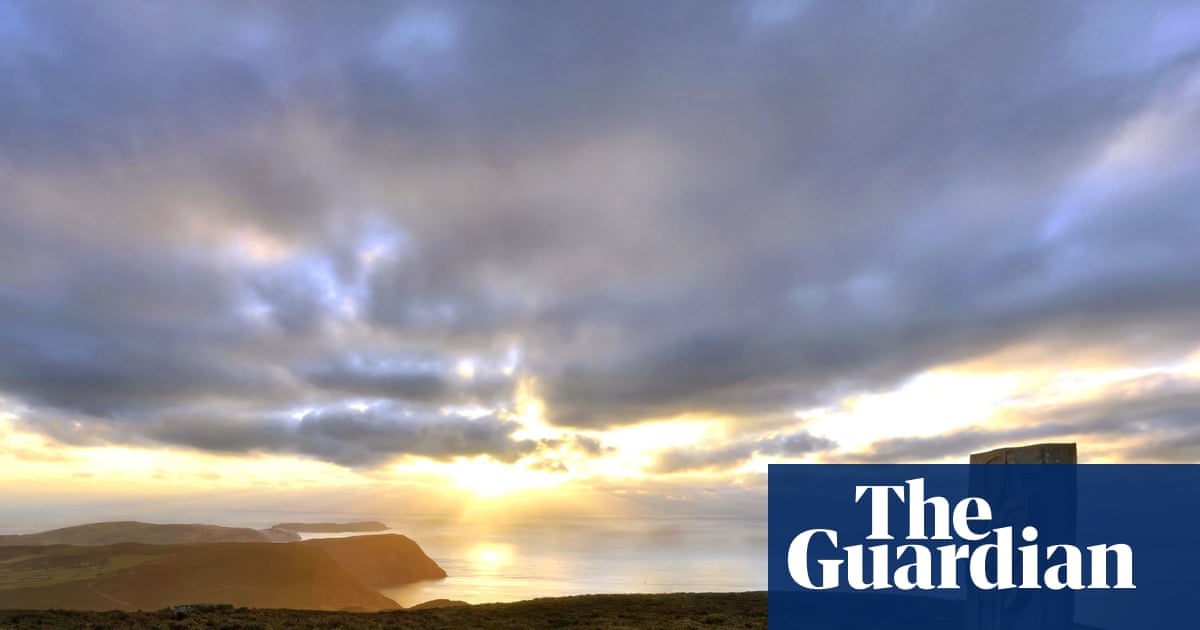
Then, one afternoon, we left the car and walked through fields to the island’s most important Neolithic monument, Cashtal yn Ard. It was in a tussocky field behind a kissing gate and a small sign. No ticket required, only some imagination and, if possible, a stone age scent hound. Behind were ranged the dark hills. The monument itself is a collapsed passage tomb that has left the ghostly imprint of its shape in rows of pale stones, marking the entrance, the tunnel, and finally, a low portal into what is left of the central chamber. Nevertheless, Stevie seemed to know the layout. He ran to the entrance, bounded down the tunnel, dodged through the portal and stopped dead. We lay on our backs and watched the skies. After a few minutes, I sneaked a look at the dog. He was curled up asleep at the exact centre of the vanished chamber.
Travel was provided by Discover Ferries, the industry body for 12 ferry companies. Irish Ferries sails Pembroke to Rosslare from £190 for car plus two (pets travel free). Isle of Man Steam Packet Company sails Belfast to Isle of Man from £179.50 for a car plus two (pets in cars free, pet-accessible cabins £75). Taking a dog to Ireland requires micro-chipping, rabies jab and tapeworm treatment (Stevie’s documents were checked at Rosslare).
Further information from Tourism Ireland, Fáilte Ireland, Tourism Northern Ireland and Visit Isle of Man





Leave a comment