
The Trump-Putin alliance threatens every European country – yet gushing populists still cheer them | Steve Bloomfield
 adminUpdated 27 minutes Ago5 Mins read
On the facade of Stenbock House, the Estonian prime minister’s neoclassical office building on a hill in Tallinn, sits a plaque commemorating the murder of 10 heads of government. They were all killed by Soviet forces after the USSR’s invasion of Estonia in 1940.
For 51 years, Estonia was occupied by its imperial neighbour; for the past 25 years it has lived independently in its shadow. For the politicians and government officials who work at Stenbock House, the plaque is a constant reminder of the risk the small Baltic nation (population 1.4 million) faces from a neighbour 100 times its size.
Not that they have needed much of a reminder. Over the past decade, there has been interference in its politics, propaganda targeting Estonia’s Russian-speaking minority, and a host of cyber and hybrid attacks, the most recent of which was an attempted arson attack targeting an Estonian defence company last Saturday.
“The goal is to create fear in our society,” Margus Tsahkna, Estonia’s foreign minister, told me by phone from Tallinn. The only thing protecting Estonia’s independence, he said, was membership of the EU and – most importantly – Nato. “Without Nato membership we couldn’t have this conversation. Estonia would have been 100% occupied.”
Long before Russia’s full-scale invasion of Ukraine in February 2022, Vladimir Putin was arguing that the decision of former Soviet or Warsaw Pact states in central and eastern Europe to seek sanctuary in Nato was an act of aggression. It’s an argument that tramples on those countries’ independence, denying them the basic right to decide their own security arrangements. Countries previously invaded, occupied or controlled by Moscow want to be protected against any repeat.
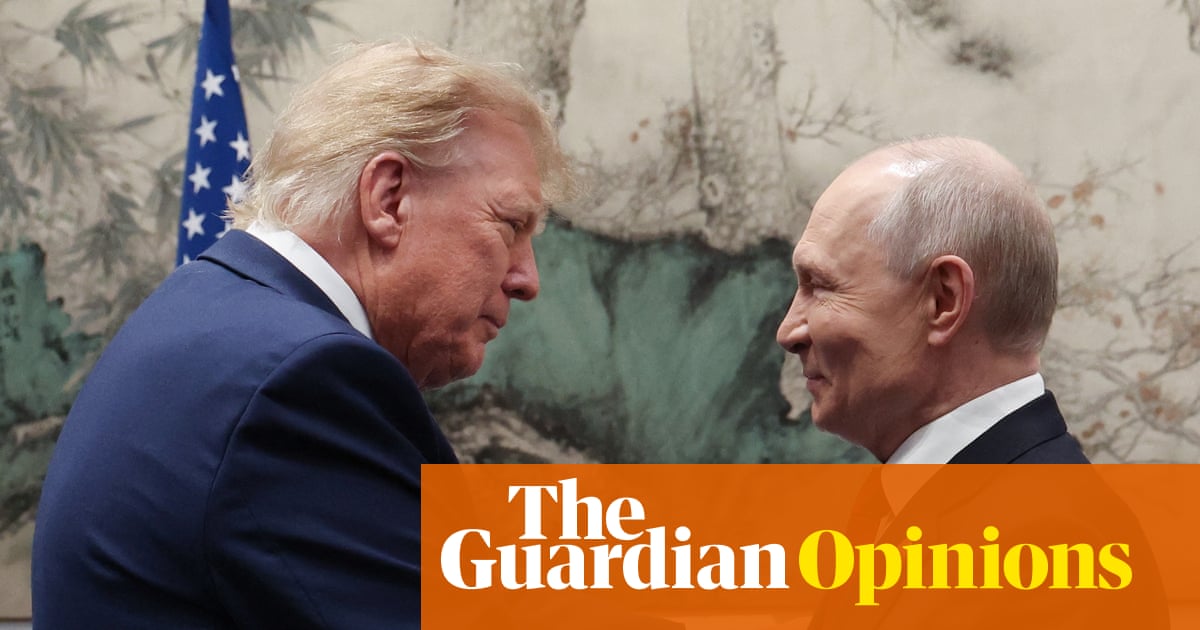
Until recently, Putin’s case gained little support among mainstream western politicians. But since Donald Trump’s return to office in January 2025, Putin has found a valuable ally in high office. “It’s my friend!” Trump excitedly said, as he greeted Putin on the sidelines of the Apec summit in Shenzhen this week.
Trump and Putin share the same view of Europe: a once-great Christian civilisation that has destroyed itself through migration, particularly from Muslim-majority countries. They also share the dangerous belief that great powers – and they both think they are – should be able to control their own back yards. For Trump, that means the western hemisphere is his; for Putin, that means the west should not interfere in central and eastern Europe. The trilateral summit in Shenzhen alongside Xi Jinping, combined with the genuine bonhomie between the two men, was partially aimed at cementing this idea.
Throughout the stop-start peace talks led by Trump’s son-in-law Jared Kushner, and his former real-estate pal Steve Witkoff, Putin has pushed the idea of broadening the discussion to include Europe as a whole, not just Ukraine. He wants Nato to withdraw its troops and bases to its 1997 borders, meaning 16 nations in the alliance would have no outside support. Estonia and the other Baltic nations would, for instance, be left without air defences. Putin has also demanded that Britain and France rule out using their nuclear weapons to protect any other European nation. Any deal for Ukraine, Putin argues, must be part of a wider agreement on Europe.
Trump seems to like the idea. Speaking to reporters in the Oval Office last week, he talked excitedly about the prospect of a grand deal. “It’s going to be very big. It’s going to involve more than Ukraine, and I could even say it might involve all of Europe. It’s going to be a big, beautiful agreement, and everyone’s going to be thrilled,” he said. Anyone who believes in a free Europe won’t be “thrilled”, but Trump doesn’t want a strong Europe, which he has long seen as an adversary. It also tallies with Trump’s other main position on Europe: that it’s a continent of freeloaders that the US has been protecting against its own national interest.
For more than a year, Europe has largely been excluded from the Ukraine talks. In Abu Dhabi, where a group of European national security advisers had come to meet on the sidelines, Kushner was upbeat about the continent finally having a formal role in future talks. But Europe has finally found itself at the table – only to discover that Europe itself is on the menu.
The Trump-Putin alliance threatens the future of Europe, not least because there are some European politicians who welcome it. In the next three years, far-right or hard-right parties could win power – or at the least join the governing coalition – in western Europe’s four biggest nations: the UK, France, Germany and Italy. The leaders of all four parties are either openly sympathetic to Putin or, at very least, critical of Ukraine’s president, Volodymyr Zelenskyy.
Marine Le Pen, who remains favourite to win the French presidency next spring, has vowed to “end financial aid” to Ukraine within six months of taking office and has refused an offer from Zelenskyy to visit him in Kyiv. In the past, she has been far happier meeting Putin – a photo of the two shaking hands featured prominently on her election leaflets in 2022, until the war in Ukraine made the image electoral poison.
In Germany, Alice Weidel, the co-leader of the Alternative für Deutschland (AfD), doesn’t attempt to hide her contempt for Ukraine. If the AfD were in power – and they currently lead Friedrich Merz’s Christian Democrats by eight percentage points – Germany would end all military and economic aid. In an interview with the Economist last month, she questioned Ukraine’s democracy, arguing it was “impossible” for them to win and, in an echo of Putin, said “Russia’s security interest” must be taken into account.
after newsletter promotion
Italy’s prime minister, Giorgia Meloni, has surprisingly been one of Ukraine’s staunchest allies, but now faces a new far-right challenger, Roberto Vannacci, whose policy on Ukraine echoes the AfD’s. Vannacci has questioned whether Alexei Navalny was killed by the Russian state, claims that Russia is a democracy and, when asked who he prefers between Putin and Zelenskyy, chose the Russian leader.
And then there is Britain. Nigel Farage is smart enough to realise that Putin is deeply unpopular in the UK, but in the past he has repeatedly expressed his admiration for the Russian leader. Following the full-scale invasion of Ukraine, Farage claimed the west had “provoked the war” by “poking the bear”, and he blamed Zelenskyy for Trump’s Oval Office ambush, accusing him of being “rude”. Last month, Farage claimed Ukraine was “one of the most corrupt countries on earth” and a Reform government would take a “keen look” at British aid to the country.
The growing popularity of the anti-Ukraine far right, most notably in France, has not gone unnoticed by Kyiv’s biggest supporters. Merz has not only promised to block the next seven-year EU budget unless there is a substantial aid package for Ukraine, but he has also proposed making any future lending subject to qualified majority voting rather than unanimity. This would mean that if a President Le Pen wanted to block an EU-wide aid package, she would need to get several other countries to join her.
But support for Ukraine may be slipping, not helped by a continent-wide cost of living crisis. “It is easy to manipulate people with easy solutions,” said Tsahkna, the Estonian foreign minister. He fears the elections in France and Germany could fundamentally reshape the continent.
Zelenskyy has long argued that Ukraine’s frontline is Europe’s frontline. The future of the continent is being fought in the Donbas, at the negotiating table and at the ballot box. The Trump-Putin alliance threatens every European nation, but the greatest danger is that those nations elect leaders who support it.





Leave a comment